

world @ goooglenews.com

By. B.V. Phani Kumar
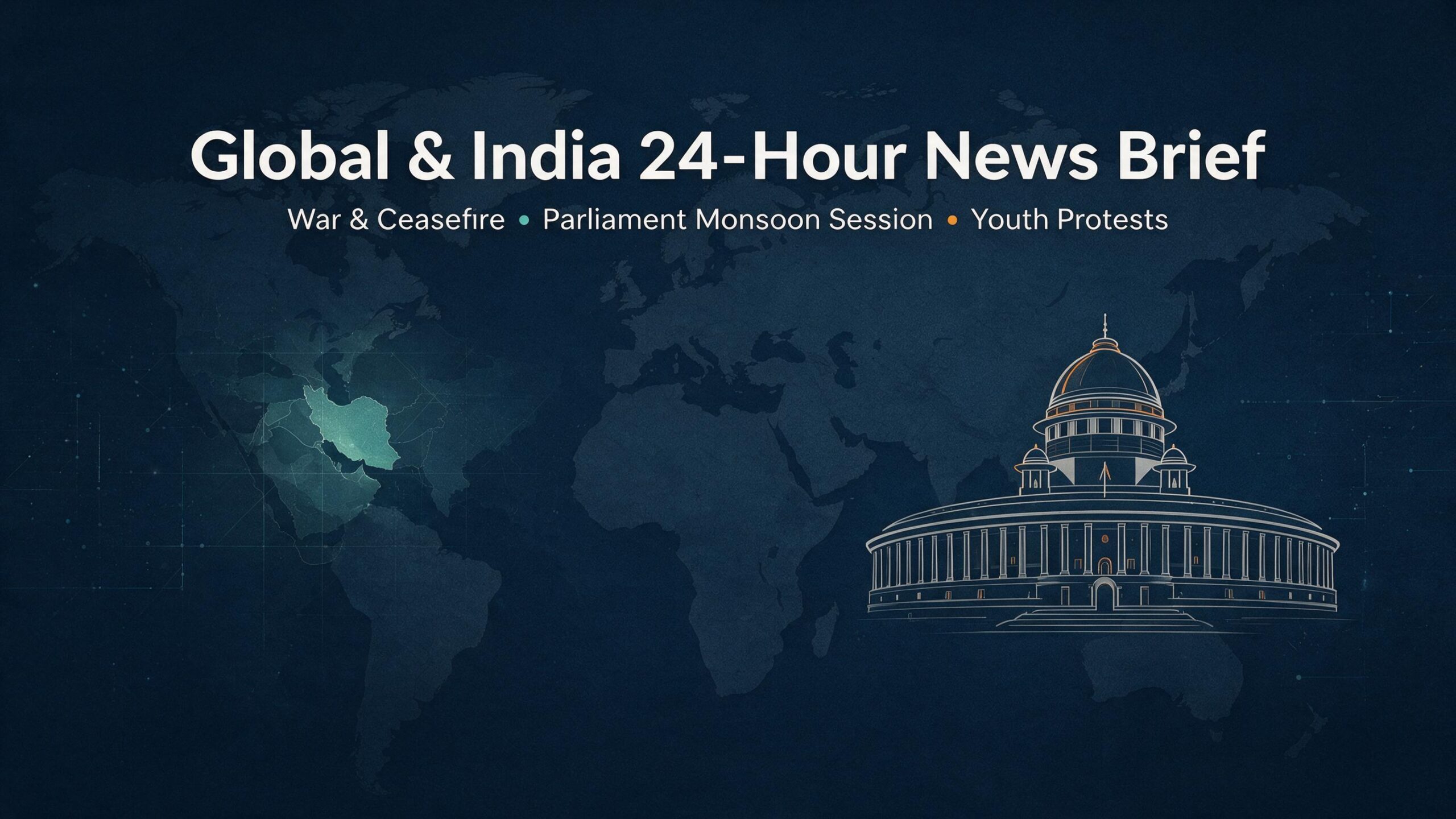
Here is a sharp, English-language global news brief for the past 24 hours spanning 15 April to 16 April 2026, with extra weight on the U.S.–Iran crisis, India including Telugu states, legal developments, and terror/safety alerts. The strongest verified themes are: fragile U.S.–Iran diplomacy under military pressure, India’s delimitation fight widening into a south-versus-centre flashpoint, and a security environment where sanctions, counter-terror finance, and geopolitical risk are driving both markets and policy.
Main read
The biggest international story remains the U.S.–Iran confrontation moving in two directions at once: public signals of continuing diplomacy from Washington, paired with Iranian warnings that U.S. naval pressure could jeopardize the ceasefire framework. In blunt political terms, this is classic coercive diplomacy: Washington appears to want negotiation from a position of force, while Tehran is trying to turn maritime pressure into a legitimacy and escalation argument.
India’s most politically explosive issue in this window is delimitation, now framed by southern parties as a test of federal fairness rather than a dry seat-reallocation exercise. That matters beyond Delhi because it directly touches Telangana and Andhra political positioning, southern regional identity, and the balance of power ahead of the next national cycle.
America-Iran focus
- Iran warned that a U.S. naval blockade threat could endanger the ceasefire, showing that maritime coercion remains the pressure point in the conflict.
- The White House said U.S.–Iran talks are “productive and ongoing,” indicating diplomacy has not collapsed despite the hostile military backdrop.
- PBS reported diplomats were laying the groundwork for another round of talks, while also noting U.S. public appetite for a prolonged conflict is weakening.
- The policy signal is mixed but deliberate: hard power is being used to narrow Iran’s room to maneuver, while diplomacy is kept alive so Washington can claim strategic restraint rather than open-ended war.
- For global markets, Reuters has already flagged the Strait of Hormuz and broader geopolitical shocks as a top systemic risk, meaning even a limited maritime flare-up can ripple into oil, shipping, insurance, and inflation expectations.
20 global highlights
- U.S.–Iran talks remain active, with Washington publicly framing negotiations as ongoing despite high regional tension.
- Iran is using the blockade issue to argue that U.S. actions themselves threaten regional stability and any ceasefire.
- Geopolitical tensions are now the top concern for central banks in Reuters reporting, reflecting how war risk is bleeding into monetary and financial stability thinking.
- Reuters polling earlier in the year showed economists still seeing global growth near 3% for 2026, but with geopolitical shocks identified as the principal downside risk.
- Markets are watching the Strait of Hormuz as the key energy chokepoint in this crisis.
- U.S. sanctions architecture remains active, with Treasury’s sanctions and counter-terror tracks updated into mid-April.
- FinCEN continued public-facing anti-money-laundering and counter-terror-finance communications, underlining that financial enforcement is still central to Western security policy.
- A monthly terrorism update from Pool Re said incidents in March 2026 showed the global terrorism threat remains complex and varied.
- Security analysts discussing the 2026 Global Terrorism Index highlighted sustained concern about terrorism’s worldwide impact.
- Sudan-related accountability remains part of the wider legal-security story, with U.S. sanctions precedent emphasizing human rights and armed-group liability.
- The broader Middle East conflict environment continues to pressure global energy supply expectations, according to Reuters market analysis.
- China has criticized U.S. blockade measures against Iran, according to BBC live coverage, while also reportedly encouraging Tehran toward talks.
- Pakistan remains diplomatically relevant as a mediation channel in the U.S.–Iran file, based on recent reporting around talks and ceasefire efforts.
- The legal-economy crossover is visible in the U.S. through major antitrust action, with PBS reporting a jury found Ticketmaster and Live Nation monopolized the market and gouged prices.
- Global investors are increasingly forced to price politics, not just growth, as strategic conflict now sits above ordinary macro indicators in risk calculations.
- Counter-terror sanctions updates from the U.S. Treasury reinforce that legal-financial pressure remains a preferred tool short of direct war.
- Maritime insecurity is again a first-order global concern because threats to shipping corridors produce immediate economic consequences.
- The international system is showing a familiar contradiction: states publicly call for de-escalation while quietly preserving leverage for the next round of talks.
- The mood in global policy circles is not panic, but it is unmistakably one of stress concentration around war spillover, sanctions, and energy disruption.
- Safety-wise, the dominant alert for global audiences is not one universal terror warning but a layered risk picture: shipping exposure, region-specific extremist threats, and sanction-sensitive travel/business environments.
30 India highlights
- India’s centre-south political fault line sharpened over delimitation.
- NDTV reported Lok Sabha seats could rise to as many as 850 in order to operationalise the women’s reservation law before the 2029 polls.
- Southern states are resisting population-based seat allocation, arguing it would punish states that better controlled population growth.
- Telangana’s BRS has taken a firm stand, with K.T. Rama Rao warning of a strong people’s movement across southern India.
- The TDP’s position is more cautious, balancing fairness concerns with its place in the BJP-led alliance.
- The proposed delimitation law reportedly includes provisions relating to Pakistan-occupied Kashmir, expanding the political symbolism of the bill.
- This makes delimitation not just an administrative reform but a national narrative contest over representation, federalism, and political reward.
- Reuters previously reported India’s services growth had slowed to a 14-month low as Middle East war impacts demand, showing external conflict is feeding into domestic business sentiment.
- The economy angle matters because India is vulnerable to imported energy shocks and external trade friction from Middle East instability.
- National politics is therefore being shaped simultaneously by constitutional redesign and external geopolitical stress.
- In Telangana, delimitation has become a high-salience political talking point, especially because it is being framed as dilution of southern voice.
- Andhra Pradesh is politically exposed through TDP’s alliance management and its need to appear regionally protective without breaking national equations.
- Telugu political media were visibly tracking Andhra and Telangana political developments through 15 April coverage.
- The south Indian response is broadening beyond Tamil Nadu, with Telangana explicitly in the conversation.
- The centre’s move gives opposition parties a federal grievance issue that can unify otherwise separate regional narratives.
- For BJP, the issue carries political risk in the south even if it creates a longer-term institutional advantage elsewhere.
- For Congress and regional parties, this is fertile terrain because it can be presented as fairness versus arithmetic majoritarianism.
- The women’s reservation linkage adds reform legitimacy to the plan, but critics are likely to say representation design should not be smuggled through under a moral banner.
- India’s policy community will now watch whether the delimitation debate turns into a parliamentary battle, a federal negotiation, or a protest issue.
- The Andhra-Telangana dimension is important because both states are part of the wider southern bloc argument, even if their party strategies differ.
- India’s news flow also remains tied to Middle East war effects, especially through services demand and business confidence.
- Any spike in oil risk from the U.S.–Iran standoff would quickly become an India inflation and current-account story.
- Legal and constitutional news is now unusually prominent in India because delimitation touches democratic structure, not just electoral management.
- Security-wise, India’s external environment remains alert due to global terror complexity and sanctions spillovers, even without a single dominant domestic terror event in the available results.
- South Asia-focused monitoring platforms remain relevant as background watchpoints for regional terrorism risk.
- Telugu-state politics should be watched through the prism of whether leaders treat delimitation as negotiation leverage or mass-mobilization material.
- This issue has emotional charge because it converts demographic success into possible parliamentary penalty, a line southern leaders are using effectively.
- Delhi’s challenge is to prevent the debate from hardening into a north-versus-south constitutional grievance.
- If mishandled, delimitation could become one of those procedural reforms that ages into a full political identity conflict.
- In practical editorial terms, delimitation is the top India political headline in this 24-hour window, while Middle East-linked economic drag is the top India economy undercurrent.
Legal watch
Legal and quasi-legal stories are carrying unusual weight right now because sanctions, antitrust, constitutional redesign, and conflict accountability are all moving together. The most notable examples in the available reporting are U.S. counter-terror sanctions activity, the Ticketmaster/Live Nation monopoly verdict cited by PBS, and India’s delimitation bill becoming a constitutional-power struggle rather than mere electoral housekeeping.
Terror and safety
For global safety readers, the risk picture is serious but uneven: there is no single universal terror emergency in the sourced material, but there is clear evidence of persistent terrorism complexity, sanctions enforcement intensification, and conflict-related maritime insecurity. The practical caution line is this: travelers, businesses, and newsrooms should watch shipping routes, sanctions compliance, and region-specific extremist developments rather than waiting for one dramatic headline to define the entire threat environment.
Editorial angle
A quiet political comment worth making plainly: when governments sell force and negotiation at the same time, they are often trying to control both reality and narrative. And when constitutional changes are packaged as fairness reforms, the real question is always who gains durable power after the applause fades.
If you want, I can turn this into a colorful modern news dashboard in HTML with:
- 20 Global cards
- 30 India cards
- separate America-Iran War Tracker
- Legal & Terror Alerts priority bar
- polished magazine-style layout in English.
Latest updates on US Marines deployment in Middle EastU.S. Marines have recently been surged into the Middle East as part of a broader escalation of the America–Iran war, with amphibious groups and expeditionary units now forming a key “trip‑wire” force in the Gulf and northern‑Arab‑sea sectors.
What units are being deployed?
- Around 3,500–5,000 Marines are now in or en route to the Middle East, split mainly between the 31st Marine Expeditionary Unit (MEU) and other MEU‑style elements.
- The 31st MEU is deployed aboard the amphibious assault ship USS Tripoli (LHA‑7) and accompanying warships, giving the U.S. a mobile “floating base” with landing‑craft and F‑35Bs capable of rapid power‑projection.
- Additional rotations from the Pacific (including up to 2,500–3,000 Marines on amphibious ships originally earmarked for other theaters) have been re‑routed to CENTCOM’s area of operations.
Where are they going and what’s the mission?
- The Marines are entering the U.S. Central Command (CENTCOM) theater, with the USS Tripoli and escorts reported in the Persian Gulf / Gulf of Oman waters, forward‑based near Saudi‑UAE‑Qatari hubs.
- Their stated mission is to bolster deterrence and “crisis‑response” capacity, including rapid‑assault options against Iranian missile‑, drone‑, and naval‑facilities, and to secure key bases from asymmetric‑terror‑or‑sabotage‑attacks.
- Public U.S. statements frame the deployment as a “escalation‑management” move: raising the cost of Iranian escalation without an immediate invasion plan, while keeping the option of a limited‑ground‑phase‑on‑the‑table as a coercive signal.
Why this matters globally and for India
- The Marine‑surge significantly raises the risk of a ground‑phase dynamic in the America–Iran war, with amphibious‑ready groups positioned near Iranian‑coastal‑areas and vital shipping‑choke‑points like the Strait of Hormuz.
- For India, this means higher odds of maritime‑disruption, insurance‑cost spikes, and potential collateral‑de‑radarisation of Indian‑owned or India‑linked vessels using Gulf‑routes, especially if Iran responds with more aggressive‑asymmetric‑naval‑operations.
- Strategically, India‑centric‑watchers are noting that the Marines’ presence shifts the conflict from a purely‑aerial‑campaign to a “hybrid” posture combining air‑, sea‑, and credible‑amphib‑pressure, which could prolong the war‑shadow‑economy and force India to harden its own energy‑and‑maritime‑security‑posture.








There are no comments at the moment, do you want to add one?
Write a comment