
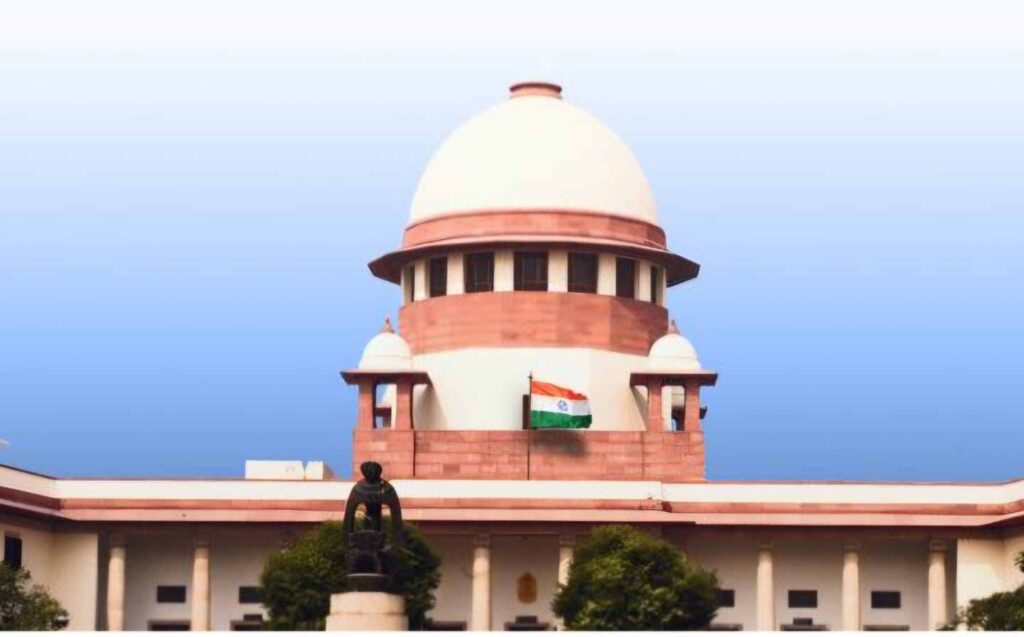
Supreme Court of India
Tamil Nadu Assembly privilege case
The Supreme Court closed proceedings concerning the Tamil Nadu Assembly privilege matter after holding that the immediate dispute had become infructuous. However, the Bench deliberately kept the underlying constitutional questions open for consideration in an appropriate future case. The decision therefore resolves the present proceeding without conclusively settling the wider limits of legislative privilege, judicial review and constitutional accountability. The ruling may remain significant because similar disputes between Governors, State Assemblies and constitutional courts are likely to return before the judiciary.indianexpress
Maharashtra political symbol dispute
While hearing the dispute over the Shiv Sena election symbol, the Supreme Court questioned whether the “sentiment of the symbol” could operate in favour of legislators accused of committing what the Bench described as the “constitutional sin” of defection. The Court also examined whether legislative strength should be treated as the primary basis for deciding entitlement to a party symbol. The observations are significant because the case touches the relationship between defections, party identity, legislative majorities and the Election Commission’s powers. The remarks were made during oral arguments and should not be treated as the final judgment.english.mathrubhumi
Preventive detention and police confessions
The Supreme Court held that a confession made to a police officer cannot, by itself, justify preventive detention unless it is supported by independent material. The principle strengthens the requirement that preventive detention must be based on credible and separately verifiable information rather than solely on an alleged confession. The decision has wider implications for personal liberty because preventive detention operates without the ordinary criminal-trial safeguards available to an accused person.scobserver
Highway safety and parked vehicles
The Court asked the National Highways Authority of India why it could not establish an electronic surveillance system to identify stationary or illegally parked vehicles on highways. The suggestion arose in the context of preventing collisions and improving emergency response. Although the observation is not itself a final direction or judgment, it signals judicial concern over highway safety, monitoring technology and institutional responsibility for preventable accidents.english.mathrubhumi
Andhra Pradesh High Court
The Andhra Pradesh High Court’s official website recorded judgments circulated on October 6, 2026. The publicly visible listing confirms that judgments were circulated, but the available index did not provide sufficient case-wise details, legal reasoning and operative directions to responsibly summarise a major ruling. Accordingly, no unverified case interpretation is included here.aphc.gov
The Court’s official portal also showed live-board and cause-list activity for October 6. Those entries establish that matters were listed and proceedings were scheduled, but a cause list should not be confused with a final judgment.aphc
Telangana High Court
The Telangana High Court’s official cause-list portal recorded court scheduling information for October 6, including benches that were not sitting for parts of the day and matters listed in hybrid mode. The available official material did not clearly identify a widely reported landmark judgment delivered within the preceding 24 hours. Therefore, it would be inaccurate to present routine listings or hearing schedules as confirmed final rulings.causelist.tshc+1
Other Courts and Legal Developments
Delhi court grants bail to protesters
A Delhi court granted bail to 17 protesters accused of unlawful assembly and obstructing public space. The court also sought a report from Delhi Police on allegations that two of the detainees were subjected to custodial torture. The order reflects the court’s attention to both the right to protest and the treatment of arrested persons. The allegations remain subject to investigation and should not be treated as established facts at this stage.english.mathrubhumi
Delhi court questions delayed arrests under MCOCA
A special court at the Rouse Avenue complex criticised Delhi Police for failing to arrest two accused persons for approximately six years despite the invocation of the Maharashtra Control of Organised Crime Act. The court sought a report from the Police Commissioner and observed that prolonged inaction could defeat the purpose of a stringent organised-crime law. The matter raises concerns about investigative delay, selective enforcement and the consequences of invoking special criminal legislation without timely police action.latestly