
By. B.V. Phani Kumar
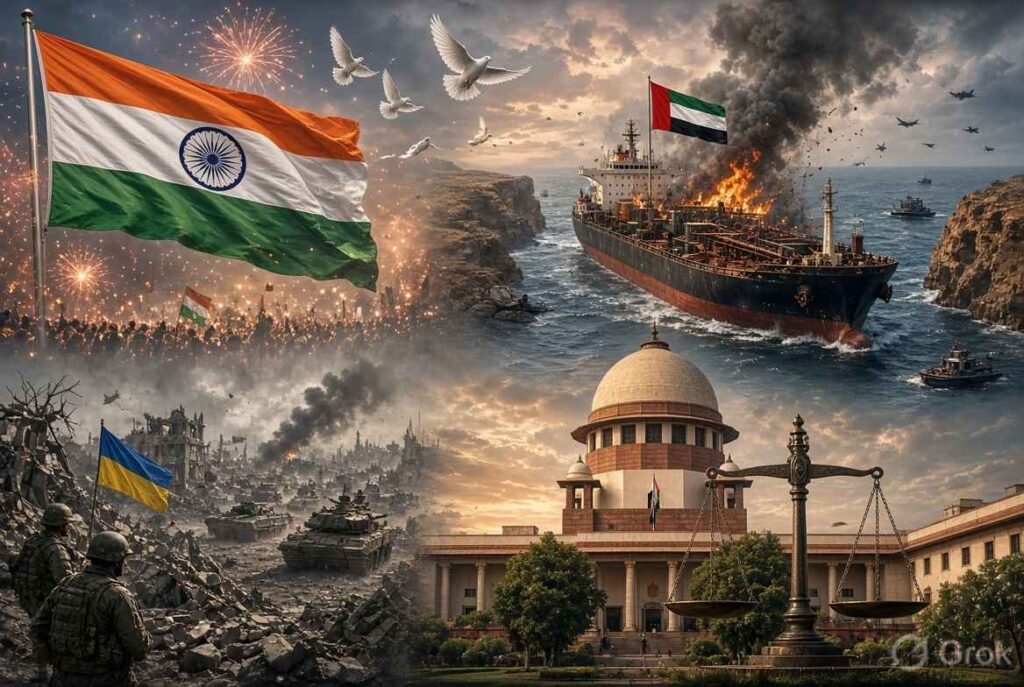
- Ukraine war diplomacy intensifies. Ukrainian President Volodymyr Zelenskyy has warned that a possible meeting between the leaders of the United States, Russia and China could allow major powers to redraw spheres of influence without Kyiv’s full participation. Ukraine wants talks among Ukrainian, Russian and American envoys in the United Arab Emirates to happen before any such summit. The war continues to cause civilian harm, with a Russian drone strike injuring five people, including a child, in Kharkiv. A limited six-day humanitarian ceasefire in Oleshky has allowed food, medicine and evacuation efforts for remaining residents.
- Russia signals openness, but warns Europe. Russian President Vladimir Putin said Moscow does not want a war with Europe but would respond to any challenge. He cautioned against restrictions on shipping in the Baltic Sea, comparing possible disruption to tensions around the Strait of Hormuz. Putin also defended recent telephone contacts with Finnish and Norwegian leaders, calling dialogue necessary to restore ties. His remarks came amid continuing Western concern over Russian military activity and energy leverage.
- US explores economic levers in Ukraine peace push. The Trump administration is reportedly examining oil, titanium and aviation-related business proposals with Russia as part of efforts to encourage an end to the Ukraine war. Ideas under discussion include restoring Russian oil flows to Europe and reviving joint energy projects. The proposals are linked to planned peace contacts involving Russian, Ukrainian and American officials. Any deal would face major political, legal and sanctions-related hurdles.
- Russian foreign minister to attend G20 meeting in the US. Sergey Lavrov is scheduled to travel to Atlanta for G20-related meetings on 30 and 31 October. The visit is significant because it places senior Russian diplomacy directly inside the United States during a period of acute tension over Ukraine. Diplomats will watch whether margins meetings produce any movement on ceasefire terms, prisoner exchanges or energy issues. The gathering also tests whether multilateral forums can still function amid great-power rivalry.
- Dockworkers plan international strike. Dockworkers across 22 countries were set to strike on Friday against war and the use of ports for arms shipments. Organisers said the action could disrupt more than 40 per cent of Mediterranean cargo and affect over 2 billion dollars worth of freight. The protest highlights growing labour-sector opposition to arms logistics linked to ongoing conflicts. Shipping companies and port authorities were preparing for delays and operational disruption.
- Middle East tensions keep oil markets on edge. Brent crude has remained above 110 dollars a barrel, with the Indian crude basket touching nearly 120 dollars. The price surge reflects geopolitical risk, supply worries and expectations of tighter availability. Higher energy costs are feeding into inflation concerns across import-dependent economies. Traders are closely watching the US Federal Reserve’s policy stance and any escalation in the region.
- US weighs tougher action against Iran. President Donald Trump is reported to be considering large-scale strikes on Iranian nuclear and military infrastructure after the US midterm elections. Washington has briefed key Gulf partners about the possibility of regional escalation and retaliatory action. The prospect has added to uncertainty in energy markets and diplomatic planning across West Asia. Gulf states are seeking to avoid being drawn into a wider confrontation.
- Global shipping faces political risk. The possible dockworkers’ action, Middle East tensions and Baltic Sea warnings have combined to raise concerns about trade routes. Freight operators fear higher insurance costs, longer detours and delays in cargo movement. Energy shipments remain particularly sensitive because chokepoints can quickly affect global prices. Businesses are reviewing contingency plans for supply-chain disruption.
- Ukraine’s humanitarian situation remains severe. The temporary truce in Oleshky is intended to help around 2,000 remaining residents receive food and medicine and to evacuate those who wish to leave. The town has been badly damaged during the Russian occupation and subsequent fighting. Aid agencies say such local pauses are useful but cannot replace a broader ceasefire. Civilian infrastructure continues to suffer from drone and missile attacks elsewhere in Ukraine.
- European leaders test direct contact with Moscow. Finnish President Alexander Stubb and Norwegian Prime Minister Jonas Gahr Store spoke directly with Putin this week, urging him to end the war. The contacts have drawn criticism in some European capitals, where leaders fear they could weaken collective pressure on Russia. Supporters argue that communication is necessary to reduce misunderstanding and explore peace openings. The episode shows growing disagreement within Europe over how to engage Moscow.
- US-China-Russia triangle shapes Asian security debate. Strategic analysts are increasingly describing Asia’s security environment as shaped by the interaction of the United States, China and Russia. Military modernisation, missile defences and nuclear signalling are pushing regional states to adjust their postures. The trend raises the risk of miscalculation, especially during crises involving Taiwan, the Korean Peninsula or the South China Sea. Smaller countries are seeking stronger partnerships while avoiding open alignment.
- Global markets remain risk-averse. Investors are balancing expectations of central-bank decisions against geopolitical uncertainty and elevated oil prices. US Treasury-market volatility has risen, while safe-haven demand has supported government bonds. Equity investors remain cautious about corporate earnings and the possibility of higher-for-longer interest rates. Emerging markets, including India, are particularly exposed to currency and capital-flow pressure.
- Media freedom concerns rise in India’s neighbourhood of democracies. A coalition of 21 Indian news organisations has approached the Supreme Court against parts of a newly enacted privacy law, saying it could restrict investigative journalism. The law is scheduled to come into force in May 2027. Publishers argue that requiring consent before reporting could amount to pre-censorship. The case is being watched globally as a test of the balance between privacy and press freedom.
- Political protests spread over war and arms trade. The planned port strike is part of a wider wave of public mobilisation against arms exports and military conflicts. Activists argue that civilian ports should not be used to move weapons destined for war zones. Governments face pressure to clarify rules on arms transit and commercial shipping. The protests could also renew debate over the economic cost of prolonged conflicts.
- Russia seeks to normalise selective ties. Putin’s outreach to Nordic leaders and his comments on restoring relations with Europe suggest Moscow wants to weaken diplomatic isolation. Russia is simultaneously warning Europe against escalation, creating a mix of engagement and threat. The approach appears designed to exploit differences among European governments. Western capitals remain divided over whether dialogue can produce meaningful results.
- Ukraine fears being sidelined in big-power bargaining. Kyiv’s concern over a possible US-Russia-China summit reflects a wider worry among smaller states that their interests may be traded away in great-power deals. Ukraine insists that any peace arrangement must protect its territory and security. The issue is likely to dominate diplomatic conversations in the coming weeks. Observers say the credibility of any settlement will depend on Kyiv’s participation.
- Energy security returns to the centre of policy. High crude prices have forced governments to revisit strategic reserves, fuel subsidies and import diversification. For India, expensive oil directly affects inflation, the current-account deficit and the rupee. For Europe, renewed talk of Russian oil flows raises difficult questions about sanctions policy. Energy diplomacy is once again becoming inseparable from security policy.
- Labour unrest becomes a geopolitical tool. The multi-country dockworkers’ strike shows how transport workers can influence international conflict policy. By targeting arms shipments, unions are attempting to raise the political cost of war logistics. Port disruptions could affect consumer goods, industrial inputs and energy cargo. Authorities will be watching whether the action spreads or remains limited to a single day.
- Global institutions face credibility tests. The G20 meeting involving Lavrov, ongoing Ukraine diplomacy and disputes over trade routes all point to strain in multilateral cooperation. Major powers are using international forums to signal positions rather than necessarily to negotiate. Smaller economies want stability, predictable trade and lower energy prices. The coming weeks will show whether diplomatic channels can deliver practical outcomes.
- Conflict-driven uncertainty dominates the global outlook. The combination of war in Ukraine, Middle East tensions, high oil prices and political protests has created a volatile environment. Businesses are delaying investment decisions where possible, while governments are prioritising energy security and diplomatic risk management. Markets are likely to remain sensitive to any military escalation or peace breakthrough. The central global question is whether diplomacy can outpace escalation.