
Israel carried out an overnight airstrike in southern Gaza and said it had killed Samir Mahmoud Hassan Abu Younis, described by the Israeli military as a senior Hamas commander. Hamas confirmed the death and announced a funeral, while the strike added to concerns over civilian safety and the fragility of the ceasefire. The development came amid continued Israeli operations across Gaza and repeated warnings from humanitarian agencies about access to medical care. Regional governments and international bodies have urged restraint and unrestricted humanitarian deliveries. The killing is likely to intensify pressure on mediators seeking a durable pause in hostilities.
Iran’s Revolutionary Guard claimed a drone attack on a United States radar system at an American helicopter base in Bahrain. Bahrain said it intercepted and destroyed incoming munitions, and American forces reported downing two Iranian attack drones. The exchange marked another escalation in the confrontation between Tehran and Washington, with both sides trading strikes and warnings. The incident raised fears that a wider regional conflict could disrupt shipping, energy supplies and civilian aviation. Diplomatic channels remain under strain, with little visible progress towards a stable ceasefire or broader de-escalation.
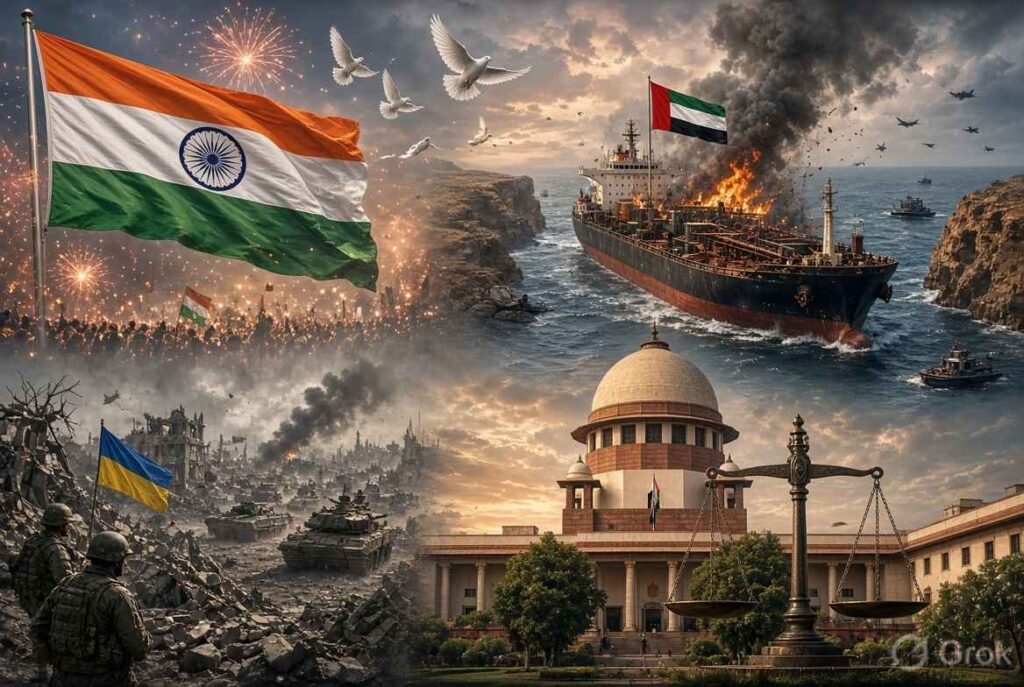
Shipping in and around the Strait of Hormuz faced renewed danger after Iranian authorities said oil tankers had struck naval mines and caught fire. The Revolutionary Guard said the vessels were travelling through restricted or unauthorised routes with navigation systems switched off. The reports immediately revived concerns over the safety of one of the world’s most important energy corridors. Insurers, shipping companies and oil traders were expected to reassess risk premiums and route planning. Any prolonged disruption could push crude prices higher and affect fuel costs across Asia, including India.
Iran rejected a German demand to halt uranium enrichment, asserting its right to enrich uranium as a member of the Nuclear Non-proliferation Treaty. Tehran also criticised the International Atomic Energy Agency over what it called non-technical speculation regarding a possible new enrichment facility near Isfahan. The dispute comes at a time when nuclear diplomacy is already complicated by the wider Iran–United States confrontation. Western governments remain concerned about enrichment levels, inspections and the possibility of further nuclear expansion. The standoff is likely to keep energy markets and regional security planners on alert.
Yemen’s Iran-backed Houthi authorities released about 600 detainees in what officials described as the largest unilateral prisoner release in the country’s twelve-year civil war. The move offered a rare humanitarian opening in a conflict that has caused enormous civilian suffering and displacement. It may also create space for further prisoner exchanges, though fighting and political divisions remain deep. International organisations welcomed the release but continued to call for protection of civilians and unhindered aid access. The development does not by itself signal a comprehensive peace settlement.
Ukraine faced another wave of Russian attacks, with authorities reporting deaths and injuries across the country and a major strike affecting energy infrastructure in the Odesa region. Ukrainian officials said about 41,000 families temporarily lost power after an energy facility was hit. Ukraine’s air force said it intercepted a large number of attacking drones overnight. The attacks underline the continuing threat to electricity supply and heating systems as winter approaches. Kyiv has repeatedly warned that damage to energy networks could worsen humanitarian conditions and complicate wartime recovery.
Ukrainian President Volodymyr Zelenskyy raised concerns over restrictions affecting Starshield, the SpaceX-operated satellite communications system used for Ukraine’s defence needs. He warned that limits on the system could weaken the country’s ability to protect energy infrastructure ahead of winter. The issue highlights the growing dependence of Ukraine’s wartime operations on private space and communications technology. It also exposes tensions between commercial operators, national security requirements and international political decisions. Kyiv is seeking assured access to communications and air-defence support through the winter months.
European Union leaders agreed that a delegation involving the United Kingdom, France, Germany, Italy, Poland and EU institutions would take part in Ukraine peace negotiations. The decision reflects Europe’s effort to maintain a collective role in any future settlement. It also signals continued European concern that a deal shaped without adequate regional input could leave security questions unresolved. Ukraine’s sovereignty, territorial integrity and long-term security guarantees remain central issues. The negotiations are expected to be difficult, with Russia and Ukraine still far apart on core terms.
United States President Donald Trump, Chinese President Xi Jinping and Russian President Vladimir Putin are scheduled to meet in Shenzhen on 19 November, on the sidelines of the APEC summit. The proposed trilateral meeting has drawn attention because it would bring together three major powers at a time of conflict in West Asia and continuing war in Ukraine. Officials indicated that Iran would be a major subject of discussion. The meeting may also test whether major-power diplomacy can reduce risks of escalation. India will watch closely, given its stakes in regional stability, energy security and trade.
The United States aviation system was recovering after a nationwide ground stop disrupted flights and left thousands of passengers affected. The Federal Aviation Administration said the air-traffic-control system had remained stable, but airlines were still working to restore normal schedules. The disruption renewed debate over ageing infrastructure, staffing pressures and resilience in American aviation. Transport authorities indicated that a copper-wire upgrade was linked to the suspension. Airlines and airports faced a difficult task in clearing backlogs and rebooking affected travellers.
New Orleans port authorities filed a one-million-dollar lawsuit connected with a tanker collision on the Mississippi River that has been described in public coverage as a “miracle on the Mississippi”. The case is expected to examine responsibility, damages and safety procedures surrounding the incident. Port operations and river traffic were affected, raising concerns about supply-chain disruption. The legal action may also prompt scrutiny of navigation safety and emergency response. Authorities are likely to focus on preventing a repeat of similar accidents.
A fire at a Canadian military base has claimed a fifth soldier’s life, deepening concern over safety standards and emergency preparedness within the armed forces. Officials said the latest death resulted from injuries sustained in the blaze. The incident has prompted calls for a full review of base safety, housing conditions and fire-response systems. Families of the deceased and serving personnel are seeking clarity on the circumstances. The Canadian government is expected to face questions over accountability and preventive measures.
Italy imposed a fine of 805 million euros on Meta over allegations connected with access to users’ photographs. The action adds to growing European scrutiny of major technology companies over data protection, user consent and platform accountability. Regulators are increasingly willing to use substantial financial penalties to enforce digital-rights rules. Meta is likely to contest aspects of the decision, while the case may influence future enforcement across the European Union. The outcome could have implications for how global platforms handle user content and privacy.
South Korea’s top scorer in a tax accountancy examination admitted to cheating, triggering a fresh controversy over academic integrity and professional recruitment. The admission has raised questions about examination security, digital cheating methods and the credibility of competitive testing. Authorities are expected to investigate how the breach occurred and whether others were involved. The case may lead to stricter monitoring and revised examination protocols. It has also sparked public debate over pressure and fairness in highly competitive professional examinations.
SpaceX achieved a major reusable-rocket milestone after its Starship spacecraft was caught mid-air by mechanical arms at its Texas launch facility. The spacecraft completed a mission lasting more than 22 hours, orbited Earth 14 times and released 26 Starlink satellites. The catch demonstrated progress in SpaceX’s effort to make heavy-lift rockets rapidly reusable. Success could lower launch costs and expand commercial and scientific space missions. The achievement also strengthens the company’s position in the global space-launch market.
Southeast Asian leaders extended a ban on Myanmar’s military leader attending regional summits, maintaining diplomatic pressure over the country’s prolonged political crisis. The decision reflects continued regional frustration with the lack of progress towards peace and civilian rule. Myanmar’s conflict has displaced large numbers of people and created cross-border humanitarian challenges. Regional bodies face criticism that their response has been too limited. The extension keeps Myanmar’s leadership outside key diplomatic forums for the time being.
Jordan sentenced three people in connection with an attack on a church, in a case that has drawn attention to communal security and religious tolerance. The court’s action is part of a wider effort to address violence and protect minority places of worship. Authorities are expected to continue investigating wider networks or motives connected with the incident. Religious leaders have called for calm and unity. The verdict may be seen as a signal that attacks on places of worship will face legal consequences.
Delhi woke to severe smog after Diwali, with firecracker emissions adding to seasonal pollution and worsening air quality. Residents reported poor visibility and health discomfort, while authorities faced pressure to enforce anti-pollution measures. The episode highlights the recurring winter air-quality crisis in north India. Experts have repeatedly warned that vehicular emissions, construction dust, crop residue burning and weather conditions combine to create hazardous air. Public-health advisories are likely to remain important for children, elderly people and those with respiratory conditions.
Devotees performed ritual bathing in the Yamuna despite a thick layer of toxic foam on the river. The images have renewed public concern over sewage treatment, industrial discharge and the ecological health of the capital’s waterways. Authorities face a difficult balance between religious practices, public health and environmental enforcement. Cleaner-water promises have repeatedly remained unfulfilled despite multiple plans and court interventions. The issue is likely to remain politically sensitive in Delhi.
New Zealand is preparing for a summer of weather extremes, with authorities warning of parched conditions in northern areas and swollen rivers in the south. Forecasters have linked the outlook to a potentially record-breaking El Nino pattern. Farmers, local governments and emergency services are being urged to prepare for both drought and flooding risks. The warning underscores how climate variability is affecting agriculture, water supply and disaster planning. Communities in vulnerable areas may need early evacuation and infrastructure readiness plans.