
By B.V. Phani Kumar
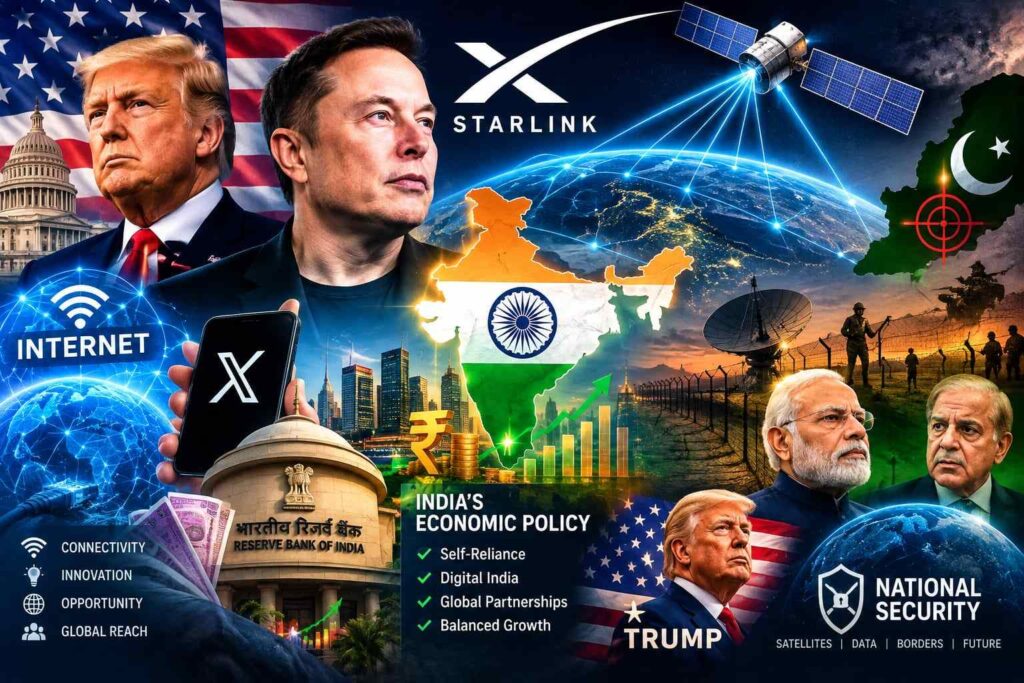
India’s hesitation over Starlink is not a quarrel with technology, nor a favour to two large business houses. It is a sovereign calculation about who controls the arteries of future communications—and whether a nation that has already tasted strategic dependence can afford to hand over part of its digital nervous system to a foreign constellation.
Elon Musk’s recent charge that “oligarchs” are blocking Starlink’s entry into India has turned a regulatory delay into a public confrontation. But the more consequential issue is not Mr Musk’s frustration. It is whether India should permit a single American company, operating thousands of satellites beyond national jurisdiction, to become a major carrier of Indian data before the country has complete confidence in the security architecture surrounding it.
A dispute larger than Musk
Mr Musk has accused unnamed Indian business interests of maintaining a “monopolistic chokehold” and preventing Starlink from launching. He has directed pointed remarks at Mukesh Ambani, whose Reliance Jio dominates Indian telecommunications, while Bharti Airtel’s Sunil Mittal is also central to the country’s telecom establishment.
India’s response has been firm. The Ministry of Communications has dismissed the allegation as “baseless and misconceived,” stating that Starlink, Reliance’s Jio Satellite Communications and Bharti-backed Eutelsat OneWeb are broadly at the same stage of approval. All three, according to the Government, must clear security requirements and receive spectrum allocation before commercial operations can begin.
That is the official position, and it deserves to be stated plainly: there is no publicly established proof that Reliance or Bharti has “blocked” Starlink. Indeed, both Jio and Airtel signed agreements with SpaceX in March 2025 to distribute Starlink equipment and services, subject to government approval—an odd arrangement for companies supposedly determined to keep it out altogether.
| Issue | Musk’s claim | India’s position | What the record supports |
| Regulatory delay | Influential interests are blocking Starlink | Rules are fair and non-discriminatory | Starlink has licences but awaits security clearance and spectrum; rivals are at a similar stage. |
| Role of Reliance and Bharti | They protect a monopoly | No operator receives preferential treatment | Both firms signed distribution agreements with SpaceX in 2025. |
| National security | Not the central issue in his public comments | Security review is mandatory | Delhi has cited concerns over unlicensed or uncontrolled terminals. |
| Pakistan | Starlink is presented as a global service | Not directly addressed in the Indian dispute | Starlink had not launched commercially in Pakistan as of 2026; its service there remains pending regulatory approval. |
The memory of Kargil
The Starlink debate cannot be separated from India’s strategic memory. During the 1999 Kargil conflict, Indian forces depended on the American Global Positioning System. At that time, the United States maintained “Selective Availability,” a technique that deliberately degraded the accuracy of the civilian GPS signal while preserving higher precision for American military users.
Accounts of the conflict differ in detail. The United States Naval Institute has written that Selective Availability degraded GPS accuracy for Indian military forces during Kargil and hindered operations. Other analysts caution that there is no open official record proving a specific Indian request for military-grade GPS was formally refused.
The distinction matters. It would be journalistically irresponsible to assert, as some social-media narratives do, that Washington secretly falsified Indian locations or deliberately led soldiers astray. The evidence supports a narrower but still serious conclusion: India fought a high-altitude war while relying on a navigation system whose precision could be controlled by another power. That experience became one of the arguments behind India’s pursuit of an independent regional navigation capability, NavIC.
The lesson was not that America is necessarily an enemy. It was that strategic autonomy is not rhetoric; it is insurance.
Why satellite internet is different
A terrestrial telecom network operates largely within Indian jurisdiction. Its towers, fibre, data centres, licences and lawful-intercept obligations fall within the reach of Indian law. A low-earth-orbit satellite constellation is different. Its infrastructure orbits above national borders, its ground stations and control systems may lie abroad, and its terminals can, in principle, be moved across frontiers.
This does not mean satellite internet is inherently unsafe. It means the burden of assurance is higher.
India’s concern, as reported, is that Starlink terminals might be used even where the service is not licensed. In a country with contested borders, insurgencies, smuggling routes and a hostile neighbour, an unregulated communications terminal is not merely a consumer gadget. It can become a tool of concealment, coordination or evasion.
The claim that Indian defence data would automatically be shared with Pakistan is not established. No credible public evidence shows that Starlink transmits Indian military communications to Islamabad. But neither can a private foreign operator offer India the same degree of legal, technical and political control that a domestically anchored network can. In matters of defence, absence of proven misuse is not the same as proven safety.
Pakistan and the American pattern
The user’s central anxiety is understandable: Pakistan has long used terrorism as an instrument of state policy, and Washington’s relationship with Islamabad has often appeared more transactional than principled. America’s post-9/11 alliance with Pakistan, its military assistance, and its tolerance of Pakistani double-dealing in Afghanistan remain painful chapters for Indian strategic thinking.
But the Starlink-Pakistan argument needs precision. Starlink has not yet begun full commercial service in Pakistan. Its own coverage map has described Pakistan as pending regulatory approval, and reports as late as September 2026 said no complete operating licence had been issued.
Therefore, the fair question is not: “Why is Starlink serving Pakistan while blocking India?” It is: “If Starlink eventually operates in both countries, what enforceable safeguards will prevent misuse, terminal diversion or foreign intelligence advantage?”
That question is legitimate. It becomes illegitimate only when it is dressed up as a proven conspiracy.
America’s contradictory economics
There is a wider diplomatic context. In August 2025, the United States imposed an additional 25 per cent tariff on certain Indian imports, explicitly linking it to India’s purchase of Russian oil; this took the cumulative additional tariff on affected goods to 50 per cent.
India’s position was not difficult to understand. It bought discounted Russian crude because energy security, inflation control and household costs matter to a developing country. Washington, however, treated India’s purchases as a punishable offence while its own energy policy continued to show flexibility towards Russian fuel when American and global market needs demanded it. Critics rightly asked why Indian purchases invited punishment while American accommodation of Russian diesel did not.
The episode revealed an old habit: rules are presented as universal, but their application often follows American convenience.
BRICS is not an anti-dollar bloc
It would also be inaccurate to claim that India is leading a BRICS campaign to destroy the dollar. India has supported local-currency settlement and more resilient payment mechanisms, particularly to reduce exposure and transaction risk. But it has repeatedly said that replacing the US dollar is not its policy, and it has opposed a common BRICS currency.
The 2025 BRICS declaration called for acceptable mechanisms of financing in local currencies; it did not announce a common currency or formally declare war on the dollar.
India’s approach is pragmatic, not ideological. New Delhi wants options, not dependence. That is precisely the same instinct that should guide its satellite-internet policy.
The real test for Delhi
India should not reject Starlink merely because Elon Musk is blunt, wealthy or politically influential. Nor should it approve Starlink merely because it promises connectivity in remote areas, where terrestrial networks remain expensive and difficult.
The correct test is whether India can secure:
- End-to-end visibility over terminals sold, activated and used within Indian territory.
- Enforceable data-localisation, lawful-intercept and emergency-response obligations.
- Independent audit rights over ground infrastructure and security arrangements.
- Protection against cross-border terminal movement and unlicensed use.
- A regulatory framework applied equally to Starlink, Jio Satellite Communications and Eutelsat OneWeb.
- A credible Indian fallback if a foreign constellation is disrupted, restricted or weaponised in a crisis.
If SpaceX can meet those conditions, India should welcome the investment and the connectivity. If it cannot, no amount of pressure from Mr Musk—or insinuations about Indian “oligarchs”—should hurry the decision.
A sovereign choice, not a business favour
Mr Musk sees India as a vast untapped market. India must see Starlink as something more consequential: a foreign-controlled layer of national communications infrastructure.
The Kargil generation learned that dependence on another country’s technology can become a strategic vulnerability at the worst possible moment. The present generation should not forget that lesson simply because the technology now arrives through a sleek terminal and a persuasive promise of universal internet.
India does not need to be anti-American to be pro-Indian. It needs to be clear-eyed. A nation that permits its critical communications to rest comfortably in another country’s orbital architecture may discover, too late, that sovereignty is not lost in one dramatic surrender. It is lost gradually—one convenience, one contract and one unexamined dependency at a time.