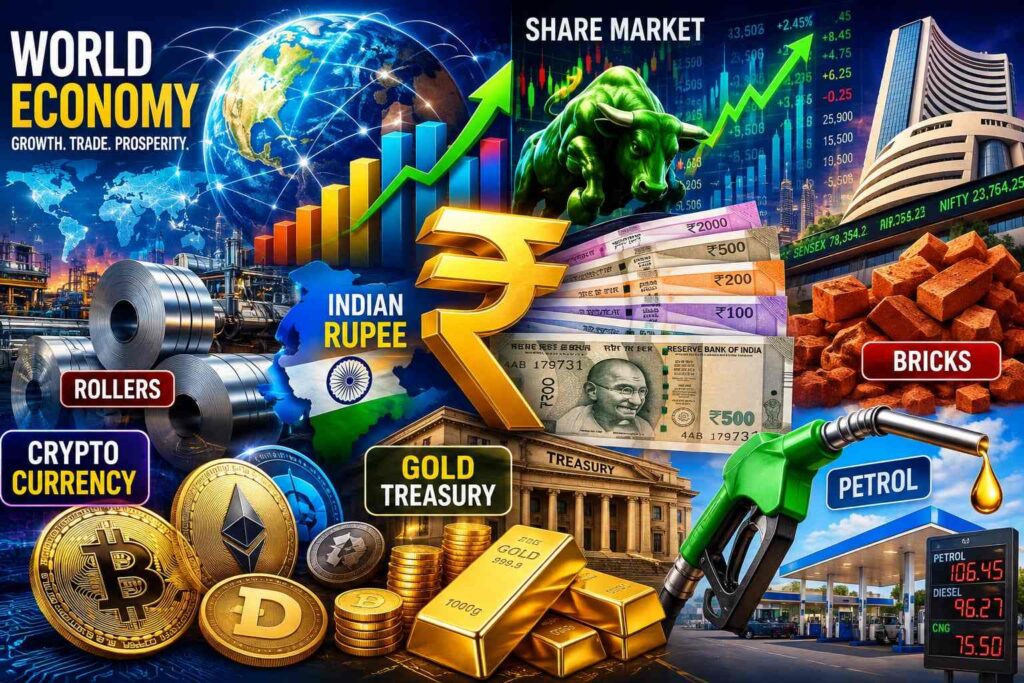
- Indian benchmark shares faced pressure as inflation concerns outweighed support measures for the rupee.
- Investors remained worried about elevated crude-oil prices and food inflation.
- Banking, IT and energy stocks were among the key areas of market attention.
- Traders are watching global cues, quarterly earnings and foreign-investor flows.
- Volatility is likely to continue amid geopolitical uncertainty.
- The rupee has remained under pressure due to higher oil prices and global dollar demand.
- The currency was recently trading around the 94-95 level against the US dollar.
- The RBI has taken measures to ease dollar demand and support the currency.
- These include a special facility to meet the daily dollar requirements of major oil marketing companies.
- The central bank’s actions aim to reduce pressure on the spot forex market.
- The RBI had raised the repo rate by 25 basis points to 5.50 percent earlier in October.
- It was the first rate increase since February 2023.
- The central bank shifted its stance to “calibrated tightening.”
- It cited broad-based food and fuel inflation, higher oil prices and a weaker rupee.
- The RBI projects CPI inflation at 5.2 percent for 2026-27.
- The Binance cyberattack put crypto assets worth about 6.3 billion dollars at risk.
- The incident affected confidence in global digital-asset markets.
- Crypto investors were watching whether the platform could prevent customer losses.
- The episode may lead to fresh calls for stronger global regulation.
- Indian crypto users and exchanges are also monitoring the fallout.
- US technology stocks fell after disappointing results from Amazon and Intel.
- Investors questioned whether AI-related spending would generate adequate returns.
- The weakness in US markets affected risk appetite across global equities.
- Indian IT stocks may face indirect pressure from global technology sentiment.
- Market participants are watching upcoming earnings and guidance from major firms.
- The US economy grew at its fastest pace in a year in the third quarter.
- The growth was supported largely by investment in artificial intelligence.
- Higher oil prices linked to the Middle East conflict remained a risk factor.
- The strong US data may influence global interest-rate expectations.
- Emerging markets, including India, are watching the impact on capital flows.
- The Centre released the 24th PM-Kisan instalment on 30 October.
- Around 9.34 crore eligible farmers were expected to receive 2,000 rupees each.
- The transfer is intended to support farm households with input and consumption expenses.
- The scheme remains a major direct-transfer programme of the government.
- Its impact is being discussed amid rising rural costs.
- Akasa Air announced a plan to increase pilots’ salaries by up to 20 percent from January 2027.
- The move reflects competition for trained pilots in India’s fast-growing aviation sector.
- Airlines are trying to retain experienced crew amid fleet expansion.
- Higher pilot costs may affect operating expenses and ticket pricing.
- The decision is significant for India’s domestic aviation market.
- Karnataka increased milk prices by 8 rupees per litre.
- The hike will affect household budgets and dairy-related businesses.
- Producers have been seeking better realisation amid rising cattle-feed and transport costs.
- Consumers may feel the impact most in urban areas.
- The decision may influence milk-price discussions in other states.
- The Bombay High Court’s refusal to shift Meta’s 1,000-crore-rupee dispute to California strengthens Indian jurisdiction.
- The ruling means the case will continue before Indian courts.
- It is important for digital-advertising and technology-sector contracts.
- Companies may need to review dispute-resolution clauses in Indian agreements.
- The decision reinforces the enforceability of Indian legal remedies.
- Rahul Gandhi questioned the proposed sale of IDBI Bank to Canada’s Fairfax.
- He argued that public-sector banks should not be treated as assets for sale.
- The issue has renewed debate over privatisation of public financial institutions.
- Bank employees and unions have opposed the move.
- The government’s position will be important for future banking-sector reforms.
- Foreign-investment sentiment remains sensitive to rupee movement, oil prices and global interest rates.
- The RBI’s forex measures are intended to reduce speculative pressure on the currency.
- Stable policy communication will be important for investor confidence.
- India continues to attract interest in technology, manufacturing and infrastructure.
- However, global risk aversion can quickly affect portfolio flows.
- The G20 discussions in Atlanta highlighted trade imbalances and critical minerals as major economic issues.
- The US is seeking to reduce dependence on China for rare earths and related inputs.
- India has an opportunity to position itself as an alternative manufacturing and supply-chain partner.
- But it must address infrastructure, processing capacity and policy consistency.
- The outcome of these discussions may shape future industrial policy.
- The European Commission’s proposed 45-billion-euro package for Ukraine may influence global defence and reconstruction spending.
- A large part is proposed for weapons procurement.
- European defence demand could benefit suppliers of equipment, components and logistics.
- Indian exporters may find selective opportunities in components and services.
- The proposal still requires approval within the European Union.
- Oil prices remain a key risk for India’s inflation, currency and current-account position.
- The Middle East conflict has kept energy markets tense.
- Higher crude prices increase import costs and can widen the trade deficit.
- The government and RBI are using administrative and forex measures to manage the impact.
- Any escalation in the region could further pressure fuel prices.