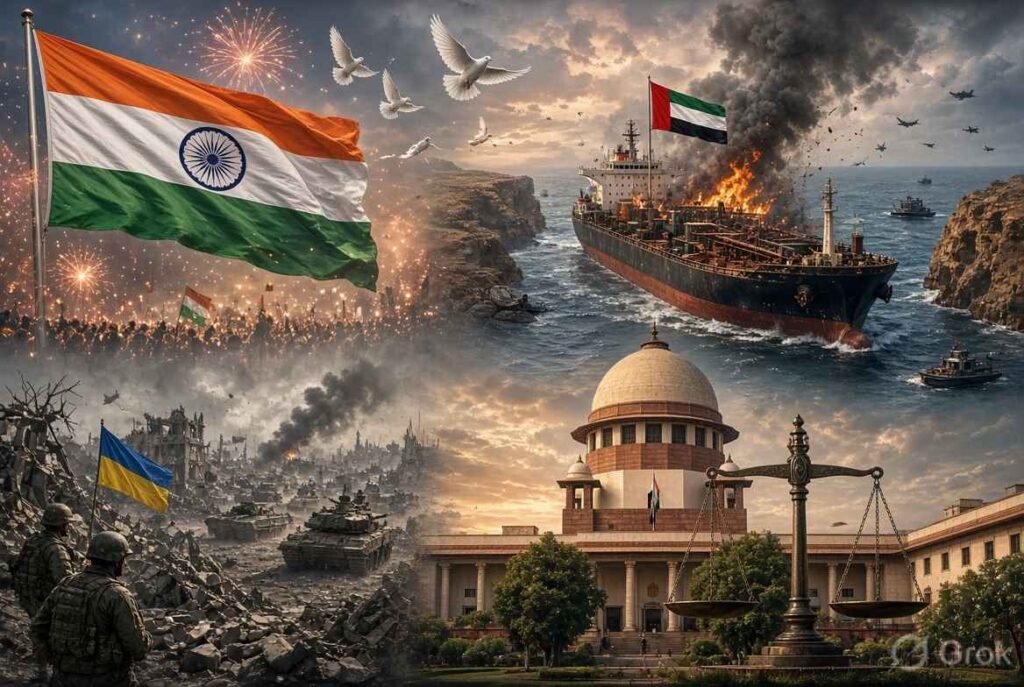
- BRICS leaders call for restraint in the Middle East.
The 11-member BRICS grouping adopted a joint declaration at its New Delhi summit urging restraint and the protection of international trade flows. The statement comes amid continuing confrontation involving Iran, Israel, Yemen and Saudi Arabia. The diplomatic significance lies in the fact that India, China, Russia and Iran joined the same appeal despite their wider strategic differences. - Red Sea tensions continue to threaten regional security.
Houthi forces claimed missile and drone activity against Saudi targets, while Saudi Arabia reported damage and casualties in the Jazan region. Iraq is investigating drone attacks and has reportedly closed three crossings with Iran. The developments underline the risk that the Middle East conflict could disrupt oil transport and commercial shipping through the Red Sea. - Houthis claim control of Mayun Island.
Yemen’s Houthi movement claimed that it had seized the strategically important Mayun Island near the Bab al-Mandab strait. Control of the island would have implications for maritime surveillance and the movement of vessels between the Red Sea and the Gulf of Aden. The claim should be treated cautiously until independently verified. - Fighting and displacement continue in Yemen.
United Nations-linked reporting indicates that at least 76,000 people have fled fighting in Yemen since July. The humanitarian situation is worsening as conflict affects access to food, health care and transport. The continuing displacement also increases pressure on neighbouring regions already dealing with instability. - Israel strikes southern Lebanon as talks are postponed.
Israeli attacks were reported in southern Lebanon while diplomatic discussions were delayed. The situation reflects the continuing danger of a wider regional escalation linked to the Gaza and Iran-related conflicts. Civilian safety and the protection of border communities remain the immediate concerns. - Iran says it is not at war with Saudi Arabia.
Iranian President Masoud Pezeshkian said Iran was not at war with Saudi Arabia, against a background of regional attacks and accusations involving Iran-backed groups. The statement appears intended to prevent the conflict from becoming a direct confrontation between Tehran and Riyadh. Its practical impact will depend on developments involving armed groups in Yemen and Iraq. - Trump speaks positively about a possible united Ireland.
During his visit to Ireland, US President Donald Trump said he would like to see a united Ireland. The comment has political sensitivity because constitutional status is a matter for the people of Ireland and Northern Ireland under the Good Friday Agreement framework. It may generate discussion in Dublin, Belfast and London. - Large protest against Germany’s far-right AfD.
Tens of thousands of people reportedly marched in Germany against the Alternative for Germany party. The protests reflect continuing concern over the party’s influence, immigration policy and nationalist political messaging. The demonstrations come as European parties prepare for further electoral contests and coalition negotiations. - Anthropic chief calls for a global AI slowdown.
Anthropic chief executive Dario Amodei reportedly called for a slowdown in artificial-intelligence development. The appeal reflects growing concern about safety testing, employment disruption, misinformation and the possibility that advanced systems may be deployed faster than regulators can respond. The debate is increasingly moving from technical circles into national policy. - Ebola reported in a seventh province of the Democratic Republic of Congo.
Ebola has reportedly spread to a seventh province, although the Congolese government says the number of cases is falling. Authorities are attempting to balance public reassurance with the need for surveillance and rapid treatment. The wider concern is whether health systems can prevent further movement of the virus across provincial boundaries. - First reported naval battle involving drones in the Black Sea.
Reports describe what is being called the first naval battle conducted mainly through unmanned systems in the Black Sea. Drone warfare is changing maritime operations by allowing attacks and surveillance without placing crews directly in danger. The development is being closely watched by militaries worldwide. - Gaza documentary receives recognition at Venice.
The documentary NAZA, dealing with the Gaza conflict, reportedly won a Special Jury Prize at the Venice Film Festival. Its recognition highlights how cinema and documentary journalism are shaping international understanding of the humanitarian consequences of war. The award is also likely to intensify debate about cultural responses to the conflict. - US marks 25 years since the September 11 attacks.
The United States commemorated the 25th anniversary of the attacks of September 11, 2001. Ceremonies focused on the victims, first responders and the long-term consequences for national security and foreign policy. The anniversary is also prompting renewed debate over the wars and surveillance policies that followed. - Mikel Landa wins a Vuelta a España stage.
Spanish cyclist Mikel Landa won stage 20 of the Vuelta a España, securing his first Grand Tour stage victory in nine years. The result was one of the major international sporting developments in the latest news cycle. The final stages remain important for the overall classification and team strategy. - Rybakina defeats Sabalenka in the US Open women’s final.
Elena Rybakina reportedly defeated Aryna Sabalenka to win the US Open women’s title. The victory adds another major achievement to Rybakina’s career and represents a significant result against one of the leading players in women’s tennis. The match was among the most widely followed sporting events of the day. - US Open men’s final attracts major attention.
The men’s final involving Ben Shelton and Alexander Zverev was listed among the leading global sports stories. The match carries importance for both players because a Grand Slam title would represent a major career milestone. It is also being viewed as part of a changing generation in men’s tennis. - Crypto billionaire makes major donation to Reform UK.
A cryptocurrency billionaire reportedly donated 49 million dollars to Britain’s Reform UK. The contribution has revived concerns about the influence of large private donations on political parties and election campaigning. British regulators and political opponents are likely to scrutinise the source and conditions attached to the funding. - Global economy remains under pressure from debt and conflict.
Recent economic analysis points to persistent government deficits, high debt, trade barriers and elevated asset prices as major risks. The Iran conflict and pressure on the Japanese yen are adding to uncertainty in financial markets. These pressures could affect interest rates, energy prices and investment decisions across countries. - US debt crosses 40 trillion dollars.
The US national debt reportedly crossed 40 trillion dollars in August. The Congressional Budget Office projection cited in the report places the 2026 federal deficit at about 1.9 trillion dollars, or 5.8 per cent of GDP. The figures are fuelling debate over fiscal discipline, taxation and the sustainability of public borrowing. - Global debt exceeds 350 trillion dollars.
Global debt reportedly exceeded 350 trillion dollars in early 2026, equivalent to roughly 305 per cent of world GDP. High debt is particularly dangerous when interest rates remain elevated or currencies weaken. Governments and companies may face higher refinancing costs if investors become less willing to hold their bonds.