By. B.V. Phani Kumar
BRICS in Delhi: A summit of resilience, resistance and quiet financial recalibration
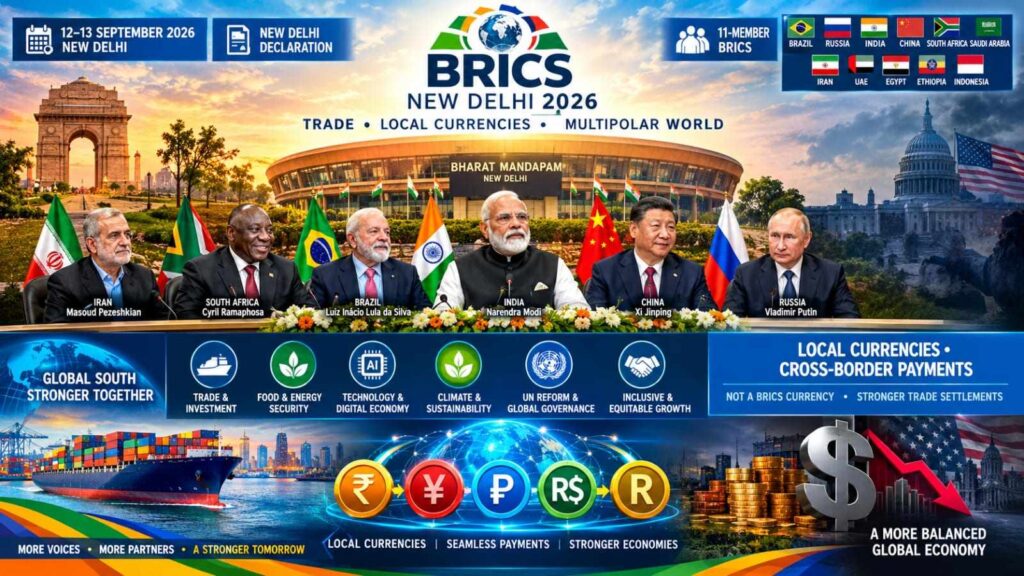
NEW DELHI, September 13: For two days, New Delhi became the meeting ground for a rapidly changing world order. The 18th BRICS Summit, hosted by India at Bharat Mandapam on September 12 and 13, brought together the expanded 11-member grouping at a moment when global trade is under pressure, conflicts are multiplying and the United States’ tariff and sanctions policies are forcing many countries to reconsider their economic vulnerabilities.
The summit’s official theme—“Building for Resilience, Innovation, Cooperation and Sustainability”—sounded developmental and inclusive. But behind the carefully drafted language of cooperation was a harder geopolitical question: can the Global South reduce its dependence on Western-controlled financial and trading systems without creating a new division in the world economy?
The answer emerging from Delhi was cautious but unmistakable. BRICS is not yet declaring war on the dollar. It is, however, preparing for a world in which the dollar will not be the only route for trade, payments and financial security.
The summit brought together Brazil, Russia, India, China, South Africa, Egypt, Ethiopia, Iran, Indonesia, Saudi Arabia and the United Arab Emirates. Their priorities were not identical. Their political relationships are often complicated. Yet, on the larger question of strengthening the voice of emerging and developing economies, the grouping managed to present a common front.
A carefully choreographed opening
The first day began with a closed-door session on “Inclusive Global Governance and Strengthening Multilateralism.” The subject itself reflected the central concern of the summit: institutions created after the Second World War no longer adequately represent the economic and political weight of Asia, Africa, Latin America and the Middle East.
BRICS leaders called for reform of the United Nations, including the Security Council, and pressed for greater representation of developing countries in global decision-making. India’s aspiration for a larger role in the UN system, including the Security Council, received support from China and Russia in the declaration.
The leaders also demanded changes in the International Monetary Fund and the World Bank. Their argument was that voting rights and leadership structures in these institutions should reflect present-day economic realities rather than the balance of power of the mid-20th century.
This was not merely a diplomatic formality. For many countries in the Global South, decisions taken in Washington-based financial institutions directly affect borrowing costs, development spending, currency stability and access to emergency finance. The BRICS position was that developing countries must have a larger voice in institutions whose decisions affect their future.
After the opening session, the leaders visited the Bharat Innovates Exhibition, where India presented its capabilities in technology, innovation, manufacturing and sustainable development. The exhibition was more than a ceremonial stop. It allowed India to place its technological and industrial ambitions before a gathering of major emerging economies.
The day ended with a family photograph and a joint tree-planting ceremony at Bharat Mandapam. The symbolism was clear: the grouping wanted to project unity, while linking economic development with environmental responsibility.
Prime Minister Narendra Modi hosted a gala dinner for the participating leaders in the evening. The dinner, although away from the negotiating table, formed an important part of the summit’s diplomatic architecture. Informal conversations between leaders often help soften disagreements that cannot be resolved in formal sessions. The arrangement also gave India an opportunity to present its cultural and culinary traditions while maintaining the restrained protocol expected at a major international summit.
Delhi itself wore the appearance of a carefully guarded diplomatic capital. Security arrangements were extensive, traffic movement was regulated and the summit venue was transformed into a tightly controlled zone. Yet, inside the venue, the emphasis was on dialogue, hospitality and the image of a confident India managing a complex and enlarged international grouping.
The second day and the wider agenda
The second day brought together BRICS members, partner countries and outreach invitees for the open session titled “Resilience, Innovation, Cooperation and Sustainability: Shaping the Future for Inclusive Global Growth.”
The four words in India’s theme covered a wide range of issues.
Resilience referred to the ability of countries to withstand wars, pandemics, food shortages, energy disruptions, financial shocks and broken supply chains. Innovation covered artificial intelligence, digital public infrastructure, space cooperation and new technologies. Cooperation addressed trade, finance, health, energy and food security. Sustainability included climate action, green finance, infrastructure and the long-term development needs of poorer countries.
The New Delhi Declaration reaffirmed cooperation across the three established BRICS pillars: political and security cooperation, economic and financial cooperation, and cultural and people-to-people exchanges. India said the intention was to make BRICS practical and people-centred rather than allowing it to remain only a platform for political statements.
Food security occupied an important place in the discussions. With conflicts and climate-related disruptions threatening agricultural production and transport routes, the members stressed the need for reliable food supplies and stronger agricultural cooperation. Energy security was discussed in the same context, particularly as oil, gas and electricity markets remain vulnerable to geopolitical tensions.
The leaders also referred to health cooperation, sustainable infrastructure, disaster resilience and the protection of critical supply chains. The pandemic had shown how quickly medical supplies, essential goods and industrial inputs could become instruments of geopolitical pressure. BRICS countries therefore sought greater coordination in health systems, medicines, technology and emergency response.
The New Development Bank remained central to the economic discussion. The grouping favoured strengthening the bank’s role in financing infrastructure and development projects in emerging economies. The broader objective is to provide developing countries with more choices in securing finance, particularly when borrowing from traditional institutions becomes expensive or politically conditional.
Tariffs and the American shadow
The sharpest economic language in the declaration concerned unilateral tariffs, sanctions and trade restrictions.
BRICS leaders criticised tariff measures imposed outside the framework of the World Trade Organization. They warned that unilateral duties and non-tariff barriers could disrupt global supply chains, increase uncertainty and deepen economic inequality.
The declaration also opposed the use of environmental concerns as a justification for protectionism. The reference was widely understood to include carbon-related border measures, such as the European Union’s Carbon Border Adjustment Mechanism. Developing countries argue that such measures could penalise their exports without providing adequate financial and technological support for the transition to cleaner production.
The summit took place under the shadow of the tariff policies of the Donald Trump administration in the United States. Washington has repeatedly used tariffs and the threat of tariffs as instruments of economic and political pressure. Several BRICS countries have either faced, or feared, higher duties, sanctions or restrictions on access to Western markets and financial systems.
The declaration condemned unilateral coercive measures and sanctions that are not authorised by the UN Security Council. BRICS countries argued that such measures can affect ordinary citizens by raising the cost of food, medicine, fuel and essential goods.
However, the Delhi summit did not produce a single anti-American economic bloc. That distinction is important. India has maintained that BRICS should not become an anti-Western alliance. New Delhi’s position is that the world needs more options, not another rigid confrontation between rival camps.
The dollar question
The most closely watched issue was the future of the US dollar in global trade.
BRICS countries supported the greater use of national currencies in trade and financial transactions among members. They also discussed faster and cheaper cross-border payment systems. The aim is to reduce exposure to currency shocks, sanctions and payment channels controlled by a limited number of Western institutions.
Reports ahead of the summit indicated that India was promoting cooperation between the central bank digital currencies of BRICS members. Such a system could eventually make cross-border payments quicker and more efficient. But political differences, uneven digital infrastructure, currency imbalances and varying financial regulations remain serious obstacles.
There was no decision in Delhi to create a common BRICS currency. Nor was there an announcement that the grouping would replace the dollar. In fact, India’s approach was more measured: diversify payment options, encourage local-currency trade and improve financial connectivity, while avoiding a premature and politically provocative currency project.
This is where the hidden agenda of the summit must be understood carefully. The objective is not necessarily to remove the dollar overnight. It is to reduce the risks of depending entirely on one currency and one financial network.
For Russia, which faces extensive sanctions, this issue is urgent. For Iran, financial restrictions are a longstanding concern. China wants greater protection from possible future sanctions and financial pressure. India wants payment arrangements that support trade without undermining its strategic flexibility. Gulf countries, meanwhile, must balance their long economic relationship with the United States against expanding commercial ties with Asia.
These interests overlap, but they are not identical. The BRICS debate is therefore less about replacing the dollar and more about creating room for manoeuvre.
Wars, conflicts and security
The summit’s political agenda extended well beyond economics.
Leaders expressed concern over conflicts in West Asia, including the continuing crisis in Gaza. They called for a ceasefire, humanitarian access and protection of civilians. The declaration reiterated support for Palestinian rights and the two-state solution, while opposing the forced displacement of Palestinians and unilateral changes to the status of Jerusalem.
The situation in Lebanon, Syria and Sudan also received attention. BRICS countries called for dialogue, respect for sovereignty and humanitarian assistance. On Sudan, they supported an immediate and permanent ceasefire and stressed the principle of an African solution to an African problem.
The declaration condemned terrorism in all its forms and rejected attempts to associate terrorism with any religion, nationality or civilisation. It called for stronger cooperation against terrorist financing, cross-border movement of terrorists, organised crime, drug trafficking, money laundering and cyber-enabled fraud.
The reference to the terrorist attack in Jammu and Kashmir on April 22, 2025, was especially significant for India. The BRICS position reiterated the need for accountability and rejected double standards in the fight against terrorism.
The leaders also discussed nuclear risks, disarmament and the protection of nuclear facilities during armed conflicts. Space cooperation, satellite technology and the reduction of space debris formed another important part of the wider security and development agenda.
Technology, artificial intelligence and a digital future
Artificial intelligence and digital infrastructure were among the emerging priorities of the summit.
BRICS countries recognised that AI could improve health, education, agriculture, public services and productivity. At the same time, they acknowledged the risks of misinformation, cybercrime, privacy violations and unequal access to advanced technology.
India’s experience with digital public infrastructure gave it an opportunity to showcase a model based on large-scale digital payments and public platforms. The challenge for BRICS will be to promote technological cooperation without compromising national security or allowing digital systems to become instruments of political pressure.
The proposed cooperation in digital payments, including possible links between central bank digital currencies, remains at an early stage. Technical standards, data protection, cybersecurity, currency convertibility and trust between member countries will determine whether the proposal moves beyond the discussion stage.
Whispers of the world
The most revealing conversations in Delhi were not always made from the podium.
One whisper around the summit was that the enlarged BRICS grouping is too diverse to act as a single strategic bloc. India and China continue to manage an unsettled relationship. Iran and the Gulf countries do not share identical security interests. Brazil and South Africa often place greater emphasis on development and reform than on direct confrontation with the West.
Another whisper was that the dollar issue is being driven as much by fear as by ambition. Countries are not abandoning the dollar because they have already found a perfect alternative. They are exploring alternatives because sanctions, tariffs and financial restrictions have demonstrated the vulnerability of excessive dependence on a single system.
A third message from Delhi was directed at Washington and Brussels: trade pressure may encourage countries to cooperate more closely. Tariffs intended to secure national advantage can sometimes accelerate the search for alternative markets, payment systems and supply chains.
But there was also a quieter message from India to its BRICS partners. New Delhi does not want the group to become an instrument of confrontation. India wants BRICS to remain open, development-oriented and flexible—strong enough to demand reform, but practical enough to maintain relations with the United States, Europe and other partners.
A declaration with limits
The New Delhi Declaration was broad, ambitious and politically significant. It covered global governance, UN reform, WTO reform, financial institutions, tariffs, sanctions, food and energy security, health, climate change, technology, space cooperation, terrorism, corruption, conflicts and development finance.
Yet the real test will come after the leaders return home.
Declarations are easy to sign; implementation is difficult. Local-currency trade requires functioning settlement mechanisms. Digital currency links require technical compatibility and political trust. Reform of the IMF, World Bank, WTO and UN depends on negotiations with countries outside BRICS. A stronger development bank requires larger resources and carefully designed projects.
The summit therefore should not be judged by whether it created a new currency or defeated the dollar. Its more immediate achievement was to place the concerns of the Global South at the centre of international debate.
For two days, Delhi hosted a group that is wider, louder and more influential than the original BRICS. Its members did not erase their differences. Instead, they built a working platform around shared anxieties: unequal representation, tariff pressure, sanctions, financial vulnerability, climate risks and the uncertain future of globalisation.
The message from Bharat Mandapam was not that the old world has ended. It was that the emerging world is no longer willing to accept its old place in the international system.
This report is based on the New Delhi Declaration, the published summit schedule and reporting on the negotiations and financial proposals. The interpretation of a “hidden agenda” is presented as analysis, not as a formally declared BRICS objective.
Dashboard: Track the 11 BRICS members’ trade-in-local-currency progress since the New Delhi 2026 Declaration
Computer
Scorecard: Analyze the 4 priorities of India’s 2026 chairship — resilience, innovation, cooperation, sustainability
Computer
What specific de-dollarisation measures were included in the New Delhi Declaration
How did the expanded 11-member BRICS handle divisions over US trade policies
What role did the New Development Bank play in the New Delhi discussions