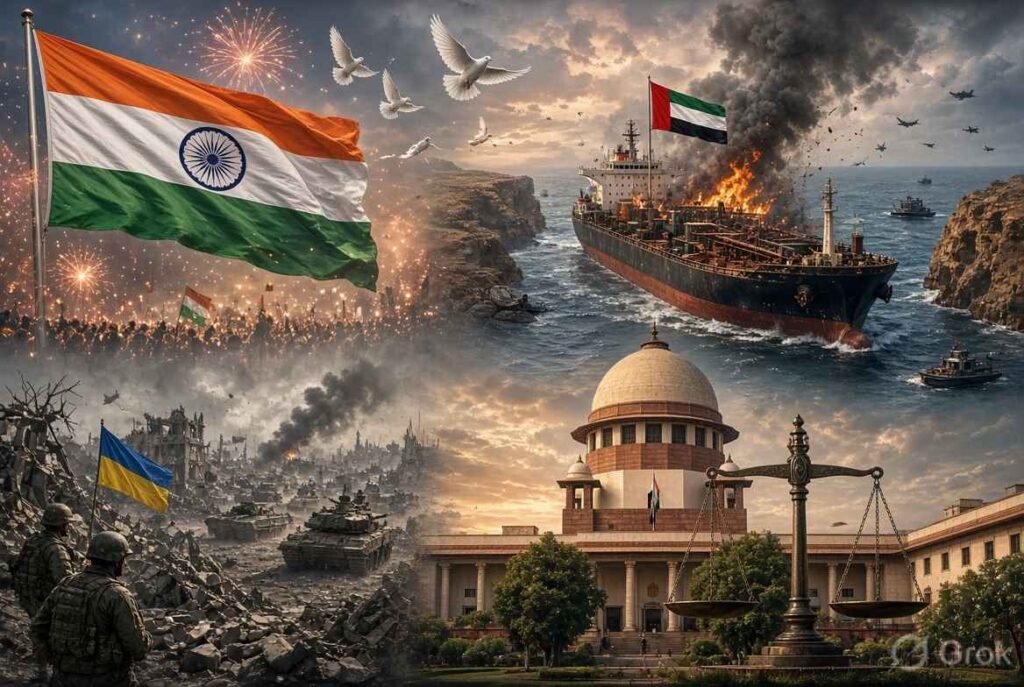
- US–Iran escalation intensifies: Fresh tit-for-tat strikes between Washington and Tehran raised fears of a wider Middle East war, with both sides exchanging fire over the Strait of Hormuz and nearby shipping lanes.
- Trump signals short campaign: President Donald Trump told reporters the renewed US military campaign against Iran would not last “too long,” even as he warned of severe consequences if Tehran retaliates further.
- Oil markets jumpy: Brent crude hovered near $95–$97 a barrel as traders priced in war risk and potential supply disruptions from the Persian Gulf.
- Bond yields spike globally: The US 10‑year Treasury yield touched its highest level since 2023, with similar moves in Germany, Japan and the UK, as inflation fears resurfaced on higher energy prices.
- Wall Street rebounds cautiously: US equities edged higher as tech shares supported indices, even as oil and bond yields stayed elevated and geopolitical risk lingered.
- IMF upgrades 2026 growth outlook: The IMF lifted its 2026 global growth projection to around 3%, but warned of persistent risks from debt, energy shocks and AI-related financial uncertainty.
- Widening global imbalances: IMF data showed excess global economic imbalances widened by 0.7% of GDP in 2025—the largest jump in a decade—driven in part by the world’s two biggest economies.
- Russia–Ukraine war grinds on: Russian drones and missiles continued to pound Ukrainian targets, while Western allies debated longer‑range strike permissions and air‑defence supplies.
- Putin’s hardline stance: Vladimir Putin reiterated that Moscow would press its war aims in Ukraine, complicating any near‑term diplomatic off‑ramps despite international pressure.
- China pushes Middle East security framework: During a rare visit to Egypt, President Xi Jinping urged a new regional security architecture, positioning Beijing as a mediator amid US–Iran fighting.
- India–China border talks resume: New Delhi and Beijing held another round of Special Representatives’ talks on their Himalayan boundary, agreeing to keep negotiating toward a “fair and mutually acceptable” settlement.
- India–Canada foreign office consultations: Officials from both countries reviewed progress on energy, critical minerals, security, defence, education and consular issues during annual talks.
- US Supreme Court clears Trump ballroom project: In a 5–4 emergency ruling, the Court allowed above‑ground construction on the White House East Wing ballroom to proceed, citing national‑security harms from halting work.
- Prediction markets reach US top court: New Jersey asked the Supreme Court to resolve a multibillion‑dollar legal battle over the future of prediction‑market platforms like Kalshi.
- Mail‑in voting registry blocked: A federal judge temporarily blocked President Trump’s executive order creating a national registry for mail‑in voters, following a string of court challenges after a Supreme Court procedural ruling.
- West Bank tensions flare: Israeli military exercises and settler raids in the northern West Bank drew sharp criticism, with Palestinian residents reporting coordinated attacks on mosques and homes.
- Nepal floods worsen: Severe monsoon flooding in Nepal left many missing and displaced, with families trekking for days to search for relatives amid damaged roads and bridges.
- Ebola response under strain: The WHO warned that the Ebola outbreak in the Democratic Republic of Congo needs a faster, better‑resourced response to prevent further spread.
- Zambia’s disputed election: Zambia’s President Hakainde Hichilema began a second term amid allegations of vote‑rigging and arrests of opposition figures, raising concerns about democratic backsliding.
- UK cabinet under scrutiny: Newly appointed UK ministers faced their first parliamentary grilling, with pledges to restore public trust after years of political turbulence.