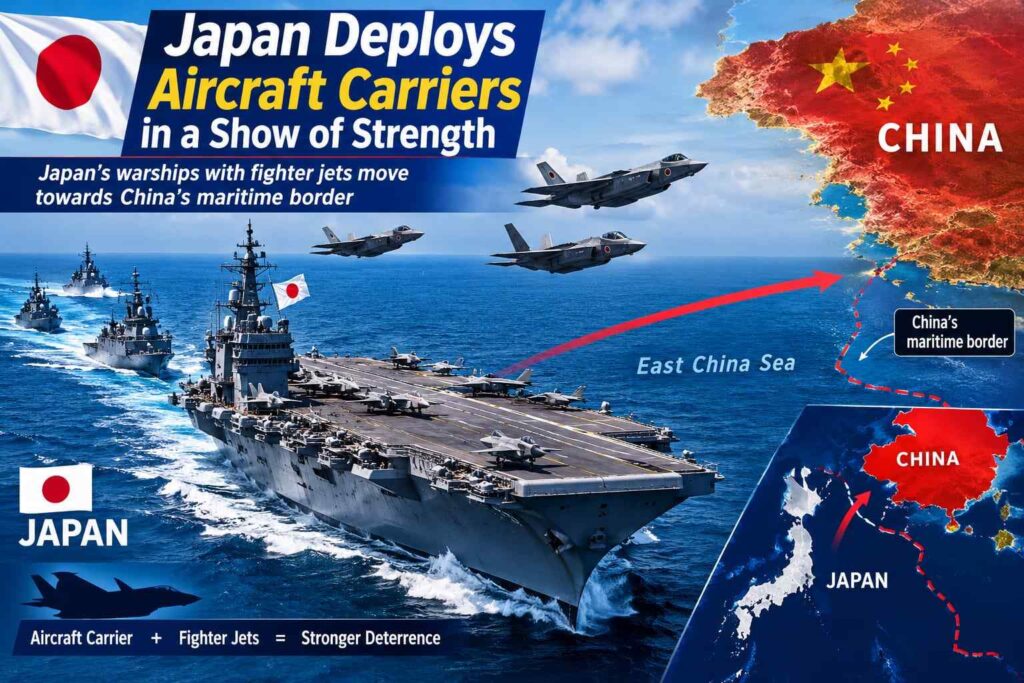
Japan is quietly but steadily reshaping its military posture to meet what it sees as a growing challenge from China. The most visible change is at sea. Japan is converting two large helicopter-carrying warships, the Izumo and the Kaga, into vessels capable of operating F-35B stealth fighter jets. These ships were originally designed mainly for helicopters, but their long flight decks, hangars and elevators make them suitable for conversion into light aircraft carriers.
The Kaga has already completed the first stage of modification, while the Izumo is undergoing its second and final stage. The full conversion work is expected to be completed in stages up to 2028 and 2029. Once ready, these ships will be able to launch and recover F-35B aircraft, which can take off over a short distance and land vertically. Japan plans to acquire 42 F-35B jets, along with a larger fleet of conventional F-35A fighters. This will give Japan a mobile air-combat capability that does not depend entirely on land bases.
The strategic reason is clear. China has been expanding its navy at a rapid pace and has deployed carrier groups, including the Liaoning, into the Western Pacific. Chinese naval activity near Japan’s southwestern islands, the East China Sea and Taiwan-related waters has increased concern in Tokyo. Japan fears that in a crisis, its airbases in Okinawa and the southwestern island chain could come under missile attack. Carrier-based fighters offer an alternative because they can operate from ships moving at sea.
Japan is not trying to match China ship for ship. Its converted carriers are smaller than China’s newer carriers and cannot carry as many aircraft. But they add something important: survivable, stealthy air power spread across a wider network of Japanese and American bases, destroyers, submarines and land-based aircraft. In simple terms, Japan is building flexibility. Even if one base or one ship is threatened, Japan wants other options to defend its territory and support the United States.
Submarines are another major part of this shift. Japan is upgrading its submarine fleet and improving anti-submarine warfare capability. Submarines are especially valuable in the waters around Japan because they can monitor Chinese naval movement, protect shipping lanes and complicate any attempt to blockade or control key sea routes. Japan is also investing in destroyers, missiles, unmanned systems, cyber capability and space-based surveillance.
The political meaning is equally important. For decades after World War II, Japan followed a highly restrained defence policy. It relied heavily on the United States for security and avoided projecting military power abroad. That approach is changing. Japan is increasing defence spending, strengthening its alliance with Washington and taking a more active role in Indo-Pacific security. The conversion of the Izumo and Kaga into fighter-capable ships is one of the clearest symbols of that change.
China says its naval exercises are routine and not directed at any country. But Japan sees the larger pattern: more Chinese ships, more carrier operations, more activity near its islands and a stronger Chinese presence in the Pacific. Tokyo’s response is therefore not a single dramatic decision but a long-term build-up across air, sea, undersea, cyber and space domains.
The result is a more competitive Indo-Pacific. Japan’s fighter-jet carriers will not by themselves change the military balance, but they send a sharp strategic signal. They show that Japan is preparing for a future in which deterrence, mobility and alliance coordination matter more than ever. For China, this means facing a Japan that is no longer content to remain only a defensive maritime power. For the United States, it means a more capable partner. For the region, it means higher military activity, closer monitoring and a greater need for careful diplomacy.