

world @ goooglenews.com

By. B.V. Phani Kumar
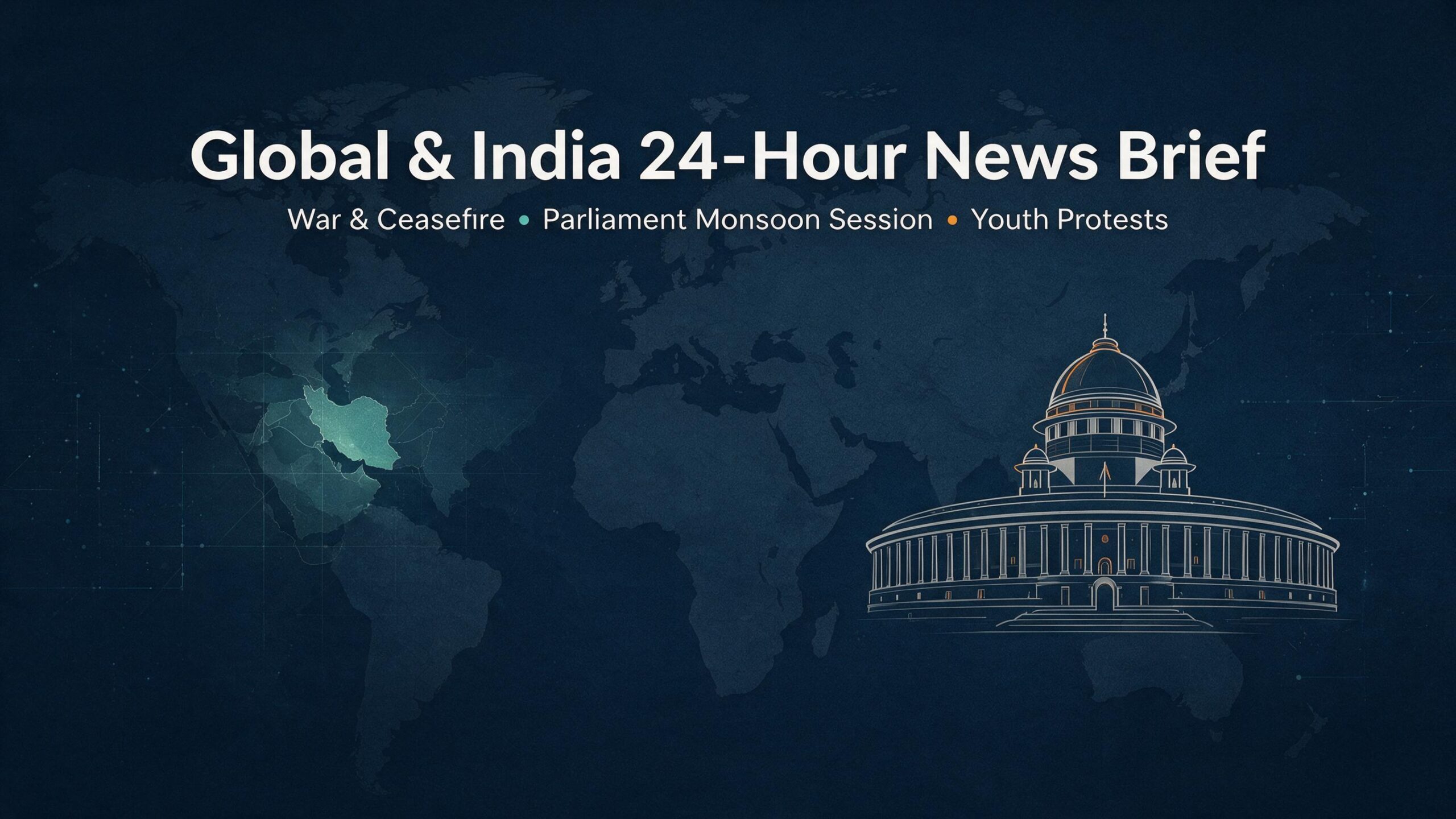
Here are the strongest verified cross-border highlights I could confirm for the last 24 hours ending April 20, 2026: the dominant global story is the Iran war’s spillover into energy, shipping, diplomacy, and market stability, while India’s lens is a mix of fuel security, maritime exposure, domestic politics, and state-level governance signals including Telugu-state coverage. Reuters’ latest front page also shows oil jumping again as the Strait of Hormuz was closed, broader concern over global growth and trade order, and intensifying pressure on supply chains an
Global pulse
- Oil rebounded sharply, with Reuters reporting Brent crude up $6.56 to $96.94 a barrel as the Strait of Hormuz was again closed, making energy and shipping security the top global economic risk in this window.
- Reuters also reported that nearly $50 billion worth of crude output has been lost since the Iran war began, indicating that the conflict is no longer just regional but a structural supply shock with global consequences.
- The IMF and World Bank meetings are being framed by Reuters as evidence of how limited existing tools are in cushioning current shocks, especially when markets still expect Washington to anchor crisis resolution.
- Reuters says a growing political fight around the U.S. Federal Reserve is adding another layer of uncertainty just as Wall Street has been recovering, which matters because war-driven commodity inflation and monetary-policy tension can reinforce each other.
- Reuters also notes that the WTO chief has said the world order has “irrevocably changed,” a remark that fits the current mix of conflict, trade fragmentation, and sanctions pressure.
America-Iran focus
- Reuters video coverage says President Donald Trump stated that a second round of talks with Tehran could resume this week, even as CENTCOM said sea trade in and out of Iran had been completely halted.
- Separate Reuters-linked reporting in search results says Trump claimed a delegation would return to Islamabad on Monday for high-stakes talks, while Tehran denied that a second round had been agreed, showing a classic wartime diplomacy gap between public signaling and actual consent.
- Search results tied to the same reporting stream say Trump also confirmed that an Iranian-flagged tanker attempting to skirt the U.S. naval blockade had been intercepted by U.S. Marines, underscoring that maritime enforcement has become a frontline theater of the conflict.
- The practical takeaway is blunt: even when leaders talk about negotiations, the conflict architecture still points toward coercive pressure at sea, sanctions escalation, and accident risk in chokepoints.
Global legal and safety alerts
- The most important global safety signal is maritime: Reuters’ reporting on a renewed Hormuz closure means commercial shipping, insurance costs, naval escorts, and crew safety remain on high alert.
- Search results also surfaced social reporting about an Indian vessel reportedly coming under attack in the Strait of Hormuz area on April 19, reflecting how merchant shipping linked to third countries is exposed even when not directly party to the conflict.
- On the legal side, Reuters reporting referenced possible sanctions on Iranian banks and oil, suggesting the next phase may broaden from battlefield measures to financial warfare with compliance implications for shipping, energy, and banking firms worldwide.
- A “whispered political comment,” kept analytical rather than partisan: once military pressure, financial sanctions, and diplomacy all run in parallel, governments often market “talks” as stability while actually bargaining from escalation, so headlines about negotiations should be read alongside enforcement actions, not instead of them.
India highlights
- The Indian Express school-headlines package for April 20 flags Iran dismissing Trump’s war claims and also highlights a drop in daily LPG demand below 50 lakh, showing how India’s domestic energy story is now being read through a war-economy lens.
- Reuters’ broader coverage of Hormuz and oil matters directly to India because imported energy costs, shipping routes, and inflation sensitivity remain tightly linked to Gulf stability.
- Search results also point to an Indian-flagged vessel, Jag Vikram, carrying 20,400 metric tonnes of LPG reaching Gujarat earlier in the week, which fits the larger Indian priority of securing cargo movement despite regional instability.
- Another search result highlighted humanitarian aid and food-security stress linked to the U.S.-Iran war, which aligns with the concern that conflict-driven commodity disruptions can hit import-dependent developing economies hardest.
Telugu states
- I could verify active Telugu-state news output for April 20 through ETV and TV9 bulletin pages, but the search results available to me did not provide sufficiently detailed, authoritative text snippets to safely itemize 10 or more separate Andhra Pradesh and Telangana developments without risking overstatement.
- What is safe to say is that Telugu newsrooms are clearly treating April 20 as a heavy cycle spanning politics, business, current affairs, and breaking news, with dedicated Andhra Pradesh and Telangana coverage streams active through the morning.
- If you want, I can next produce a Telugu-states-only verified bulletin for the same 24-hour window with separate Andhra Pradesh and Telangana sections, but I would want to use another retrieval pass focused only on those states so the details are solid.
Political reading
- The core political pattern across the globe is that leaders are trying to sound in control while markets are pricing disorder, especially through oil, shipping, and sanctions channels.
- In India, the political value of energy management is rising because every fuel headline now doubles as a cost-of-living and national-security headline.
- In Washington and allied capitals, the subtext is that “limited war” is becoming harder to sell when trade routes, central banks, insurers, and importers are already paying the bill.
Modern layout option
If you want this “modernised with colourful layout” exactly as a polished English news dashboard, I can build it next as a visually rich single-page web brief with:
- 20 Global cards.
- 30 India cards including AP and Telangana.
- High-priority legal and terror/safety alert strip.
- America-Iran war tracker.
- Color-coded sections for politics, economy, security, diplomacy, and markets.
- A more editorial tone with restrained political side-comments.
At the moment, the safest verified summary is that the last 24 hours were dominated by the Iran conflict’s effect on shipping, oil, diplomacy, sanctions risk, and India’s energy-security calculations.
Latest updates on US Marines deployment in Middle EastU.S. Marines have recently been surged into the Middle East as part of a broader escalation of the America–Iran war, with amphibious groups and expeditionary units now forming a key “trip‑wire” force in the Gulf and northern‑Arab‑sea sectors.
What units are being deployed?
- Around 3,500–5,000 Marines are now in or en route to the Middle East, split mainly between the 31st Marine Expeditionary Unit (MEU) and other MEU‑style elements.
- The 31st MEU is deployed aboard the amphibious assault ship USS Tripoli (LHA‑7) and accompanying warships, giving the U.S. a mobile “floating base” with landing‑craft and F‑35Bs capable of rapid power‑projection.
- Additional rotations from the Pacific (including up to 2,500–3,000 Marines on amphibious ships originally earmarked for other theaters) have been re‑routed to CENTCOM’s area of operations.
Where are they going and what’s the mission?
- The Marines are entering the U.S. Central Command (CENTCOM) theater, with the USS Tripoli and escorts reported in the Persian Gulf / Gulf of Oman waters, forward‑based near Saudi‑UAE‑Qatari hubs.
- Their stated mission is to bolster deterrence and “crisis‑response” capacity, including rapid‑assault options against Iranian missile‑, drone‑, and naval‑facilities, and to secure key bases from asymmetric‑terror‑or‑sabotage‑attacks.
- Public U.S. statements frame the deployment as a “escalation‑management” move: raising the cost of Iranian escalation without an immediate invasion plan, while keeping the option of a limited‑ground‑phase‑on‑the‑table as a coercive signal.
Why this matters globally and for India
- The Marine‑surge significantly raises the risk of a ground‑phase dynamic in the America–Iran war, with amphibious‑ready groups positioned near Iranian‑coastal‑areas and vital shipping‑choke‑points like the Strait of Hormuz.
- For India, this means higher odds of maritime‑disruption, insurance‑cost spikes, and potential collateral‑de‑radarisation of Indian‑owned or India‑linked vessels using Gulf‑routes, especially if Iran responds with more aggressive‑asymmetric‑naval‑operations.
- Strategically, India‑centric‑watchers are noting that the Marines’ presence shifts the conflict from a purely‑aerial‑campaign to a “hybrid” posture combining air‑, sea‑, and credible‑amphib‑pressure, which could prolong the war‑shadow‑economy and force India to harden its own energy‑and‑maritime‑security‑posture.









There are no comments at the moment, do you want to add one?
Write a comment