By. B.V. Phani Kumar
Donald Trump built his political career on a simple, thunderous promise:
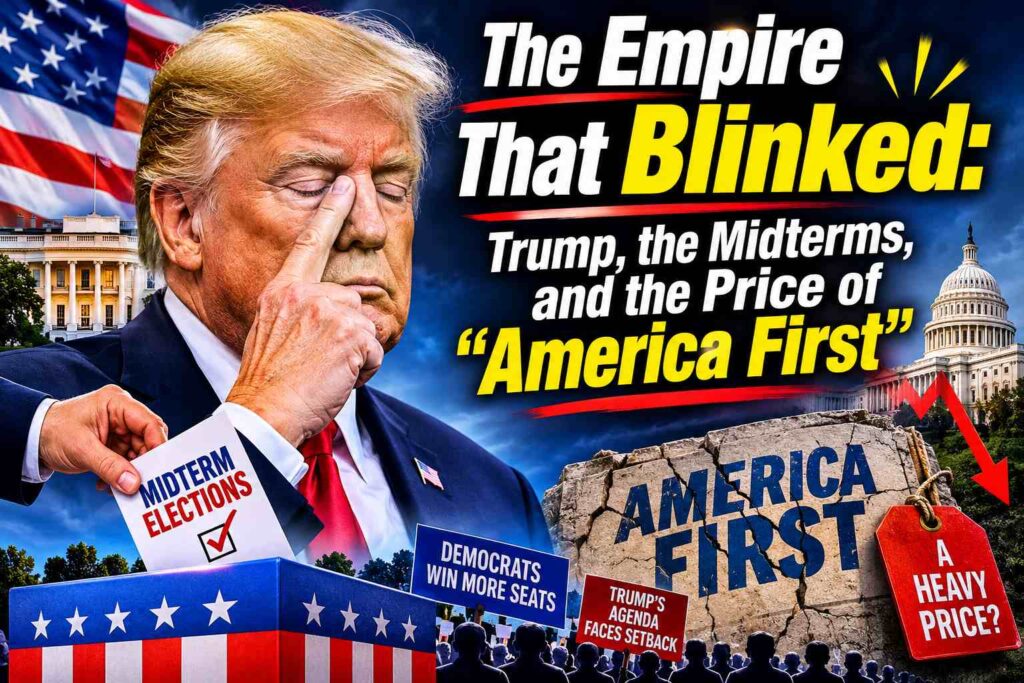
America would no longer be cheated, no longer be lectured, no longer be asked to carry the world. But the 2026 midterm elections have turned that promise into a question mark. Democrats have captured both the House and Senate in what major outlets describe as a historic repudiation of Trump and his Republican allies, with voters punishing a presidency defined by tariffs, inflation, abrupt aid cuts, and a foreign policy that treated allies as bargaining chips.
This is not merely an electoral defeat. It is a verdict on a style of power: loud, personal, transactional, and often indifferent to the human wreckage left behind.
From Escalator to Reckoning
Trump’s political journey began in 2015 not with policy blueprints but with spectacle—escalators, crowds, slogans, and an argument that the American establishment had betrayed its own people. He won the presidency in 2016, lost in 2020, refused to accept that result peacefully, and then returned to the White House in 2025. His second term began with executive orders that withdrew the United States from the World Health Organization and froze foreign assistance worldwide.
The midterms now mark the sharpest rupture in that arc. Democrats flipped seven Republican-held Senate seats, including in Iowa, Kansas, Maine, North Carolina, Ohio, South Carolina and Texas, and took governorships in Texas and Georgia. The party that presented itself as the voice of forgotten Americans has been told, forcefully, that many Americans feel forgotten by it.
The First Term: Cruelty as Policy
Trump’s first presidency normalized a politics of provocation. Its most damning human-rights legacy was the “zero tolerance” border policy, which separated migrant children from their parents. Investigations and court records later documented thousands of separations, including families with no clear mechanism for reunion. The policy was defended as deterrence; in practice, it turned children into instruments of state messaging.
The first-term travel bans targeting several Muslim-majority countries likewise sent a message far beyond immigration paperwork: that faith and nationality could determine one’s claim to American dignity. Critics called it discrimination; supporters called it security. But the human cost was borne by families split at airports, students barred from universities, and refugees denied protection.
His first term also weakened international institutions, questioned alliances, and treated diplomacy as a reality show. Yet the deeper failure was not any single decision—it was the substitution of grievance for strategy. America’s power was real; Trump’s genius was to make grievance feel like power.
The Second Term: Aid Withheld, Lives Endangered
In his second term, Trump did not merely criticize the global aid architecture. He dismantled it. On his first day back in office, he ordered a near-total freeze on U.S. foreign assistance; within weeks, roughly 83 percent of USAID programmes—about 5,200 contracts—were cancelled. By July 2025, USAID’s independent operations had ceased, with 94 percent of its staff laid off.
The consequences were not abstract. The United States had supplied an estimated $13.9 billion in humanitarian aid in 2024, about 42 percent of aid tracked by the United Nations. When that flow stopped, field hospitals, landmine-clearance teams, HIV treatment programmes, refugee shelters and food distribution systems faced immediate collapse.
Human Rights Watch found that the cuts halted investigations into abuses, cut support to victims, and forced organisations protecting communities at risk to scale back or shut down. Its review covered Afghanistan, Bangladesh, Ukraine, Myanmar, Venezuela and other countries.
Afghanistan: Abandonment at Its Coldest
Afghanistan illustrates the cruelty of sudden withdrawal. The Trump administration terminated Afghan aid programming and cut more than $560 million slated for 2025, including support for women’s health, protection and basic services. More than 420 health facilities have since closed or suspended operations.
In 2026, an estimated 21.9 million Afghans need humanitarian assistance; women and girls account for more than 10.7 million of them. Yet the United States committed no humanitarian funding at all to Afghanistan. For a country already crushed by Taliban rule, economic collapse and famine risk, this was not “America First.” It was America looking away.
Bangladesh and the Rohingya: A Waiver Is Not a Rescue
Bangladesh hosts more than a million Rohingya refugees who fled Myanmar. Washington did grant a waiver for emergency food aid, but the exemption did not cover shelter, protection and other humanitarian programming. Aid workers warned that organisations could no longer buy materials to build or repair homes for refugees.
That distinction matters. A ration card keeps someone alive today; shelter, sanitation, education and legal protection determine whether they have a future. By treating humanitarian aid as a line item to be slashed, the administration shifted the burden onto Bangladesh—one of the world’s most densely populated and climate-vulnerable countries—without offering a credible alternative.
Ukraine: An Ultimatum Disguised as Peace
Nowhere was the contradiction starker than Ukraine. In March 2025, after a hostile Oval Office meeting with President Volodymyr Zelensky, Trump temporarily suspended all U.S. military aid to Ukraine. The freeze affected more than $1 billion in weapons and ammunition already in the pipeline or on order.
Kyiv was fighting a full-scale Russian invasion. The suspension was presented as pressure for peace negotiations, but it functioned as an ultimatum: accept terms dictated from Washington, or face greater battlefield losses. Meanwhile, the same administration moved swiftly to release 1,800 MK-84 2,000-pound bombs to Israel and later used emergency authority to expedite nearly $4 billion in arms sales.
That asymmetry—punishing one invaded ally while arming another in a devastating war—did not look like principled diplomacy. It looked like favouritism enforced by leverage.
Israel and Gaza: Weapons Without Limits
Trump’s approach to Israel was defined by unconditional military and political backing. He lifted the Biden-era pause on 2,000-pound bombs, exempted Israel from the global aid freeze, and notified Congress of more than $8 billion in arms sales in early 2025.
Support for Israel’s security is a legitimate policy position. But unconditional supply of heavy munitions during a war with catastrophic civilian casualties raises a moral and legal question that cannot be waved away: when does support become complicity? Human-rights organisations argued that the aid cuts harmed victims worldwide even as military assistance continued to flow to Israel.
Then came the latest twist: in November 2026, Trump announced that the United States would end roughly $4 billion in annual aid to Israel by year’s end, saying Israel “doesn’t need it.” After years of treating Israel as the ultimate exception to every aid cut, the abrupt reversal reinforced the same impression: alliances were not principles; they were invoices.
Tariffs: Revenge Dressed as Patriotism
Trump’s tariff policy was sold as economic nationalism. In practice, it often operated as retaliation. India felt this directly. After talks collapsed, Washington imposed a punitive 50 percent tariff on most Indian goods in August 2025; a later framework reduced it to 18 percent.
For Indian exporters—textiles, pharmaceuticals, engineering goods, seafood, gems and jewellery—the difference between 18 percent and 50 percent is not a technicality. It determines orders, factories, jobs and livelihoods. The midterms may now give New Delhi more room to resist a return to tariff warfare, but the damage to trust has already been done.
| Issue | Key figure | Human or economic consequence |
| USAID programmes cancelled | About 5,200, or 83% | Humanitarian, health and rights programmes disrupted worldwide. |
| USAID staff laid off | 94% | Institutional capacity for relief and development dismantled. |
| U.S. share of tracked global humanitarian aid, 2024 | $13.9 billion, 42% | Sudden freeze endangered food, medicine and shelter systems. |
| Ukraine military aid paused | More than $1 billion | Weapons and ammunition already in the pipeline were halted. |
| Afghan aid cut for 2025 | More than $560 million | Over 420 health facilities closed or suspended operations. |
| Afghans needing aid in 2026 | 21.9 million | Women and girls make up over 10.7 million of those in need. |
| Israel arms sales notified, February 2025 | Over $8 billion | Included a $6.75 billion munitions sale, the largest since 2015. |
| U.S. annual aid to Israel, ending in 2026 | About $4 billion | Trump announced the cutoff at the end of 2026. |
| Punitive tariff on most Indian goods, August 2025 | 50% | Later reduced to 18% under a trade framework. |
| 2026 midterm outcome | Democrats win House and Senate | Voters delivered a sweeping rebuke to Trump’s Republicans. |
India: The Soft Hammer
For India, Trump’s return has been a lesson in the difference between partnership and dependence. New Delhi values its strategic ties with Washington, but Trump’s tariffs showed how quickly friendship can become coercion. A 50 percent duty on Indian goods was not merely a trade measure; it was a political signal that access to the American market could be switched on or off at will.
The economic losses are real: export competitiveness weakened, supply chains reconsidered, and Indian negotiators forced to spend political capital defending market access rather than expanding it. Yet India’s response has been notably measured. It has continued negotiating, seeking a deal only when it secures an advantage over competing exporters. That is not weakness; it is statecraft.
What the Midterms Mean
The 2026 result does not erase Trump’s influence. His movement remains powerful, his base loyal, and his instinct for confrontation undiminished. But Democrats now control Congress for the remainder of his presidency, limiting his ability to pursue another unilateral trade war or push through policies without resistance.
The deeper message is this: Americans may tolerate bravado, but they eventually count the cost—at the grocery store, in global instability, and in the country’s moral standing. Trump promised to make America feared again. The midterms suggest that many voters have concluded that fear is not the same as respect.
A great power earns influence not by threatening friends, abandoning the vulnerable, or punishing those who say no. It earns it by being reliable. On that measure, the Trump era has left America poorer—not only in dollars, but in trust.